
- The Full-Body Circuit Structure
- 1. Push-Ups
- 2. Bodyweight Squats
- 3. Plank to Shoulder Tap
- 4. Reverse Lunges
- 5. Supermans
- 6. Mountain Climbers
- 7. Glute Bridge
- 8. Plank Hold (1 Minute)
- How to Keep Progressing Without Adding Weight
- Nutrition Support for Muscle Growth
- Recovery Matters Just as Much as the Workout
- Why This Approach Genuinely Works
- The Bottom Line
You don’t need a gym membership or fancy machines to get stronger, leaner, and more defined. With the right bodyweight exercises, you can build genuine muscle using only resistance from your own body.
Research actually supports this directly. A study comparing novice trainees using machines, free weights, or a combination of both found similar strength and muscle gains across all groups, suggesting that the specific equipment matters far less than consistent effort and genuine progressive challenge. ¹ Bodyweight training follows this same basic principle, and this guide covers exactly how to structure it, progress it over time, and support it with the right nutrition and recovery.
Soreness is nearly guaranteed in your first few weeks of a new routine like this one. This guide on how to relieve sore muscles in your thighs can help you recover faster between sessions. Let’s walk through a complete, no-equipment muscle-building workout.
The Full-Body Circuit Structure
Perform each exercise for 40 seconds, rest for 20 seconds, then move to the next. Complete the full circuit of all 8 exercises 3 times total, taking a 1 to 2 minute break between full rounds.
Each move in this circuit targets multiple muscle groups at once while improving functional strength, meaning you’ll build a body that performs better in everyday life, not just one that looks a certain way. Move with control, keep your heart rate up, and prioritize good form over speed throughout.
This full-body approach is genuinely well-suited for home training specifically, since it means you don’t need separate “leg day” or “arm day” sessions requiring different equipment setups. One consistent circuit, performed several times a week, is enough to meaningfully challenge every major muscle group.
1. Push-Ups
Start in a high plank position with your hands slightly wider than shoulder-width apart. Keep your body straight from head to heels, avoiding sagging hips or an arched back. Lower your chest toward the floor by bending your elbows to about a 45-degree angle, pause briefly near the bottom, then press back up with control.
If a full push-up feels too difficult right now, drop to your knees for a modified version, or perform them against a wall or elevated surface like a countertop. This isn’t a lesser version; it’s simply the right starting point for building toward the full movement.
2. Bodyweight Squats
Stand with your feet shoulder-width apart, toes slightly turned out. Engage your core and keep your chest upright as you push your hips back and bend your knees, lowering your body as if sitting into a chair. Go as low as comfortably possible while keeping your heels flat on the floor, then drive through your heels to return to standing.
3. Plank to Shoulder Tap
Begin in a high plank position with your hands directly under your shoulders. Tighten your core and glutes to keep your body stable, then lift one hand to tap the opposite shoulder before returning it to the floor. Alternate sides while keeping your hips as still and level as possible throughout.
4. Reverse Lunges
Stand tall with your feet hip-width apart. Step one leg back and lower your body until both knees reach roughly 90 degrees, keeping your front knee positioned over your ankle rather than pushing past your toes. Push through your front heel to return to standing, then repeat on the opposite side.
5. Supermans
Lie face down with your arms extended overhead and your legs straight. Simultaneously lift your arms, chest, and legs off the floor as high as comfortably possible, hold for 1 to 2 seconds while squeezing your glutes, then lower slowly and repeat. This exercise directly targets your lower back and glutes, muscles that often get neglected in home routines focused mainly on the front of the body.
6. Mountain Climbers
Start in a high plank position with your hands directly under your shoulders. Drive one knee toward your chest, then quickly switch legs as if running in place, keeping your hips low and your core tight throughout the movement.
7. Glute Bridge
Lie on your back with your knees bent and feet flat, hip-width apart. Press through your heels to lift your hips until your body forms a straight line from your shoulders to your knees, then squeeze your glutes at the top for 2 seconds before lowering back down.
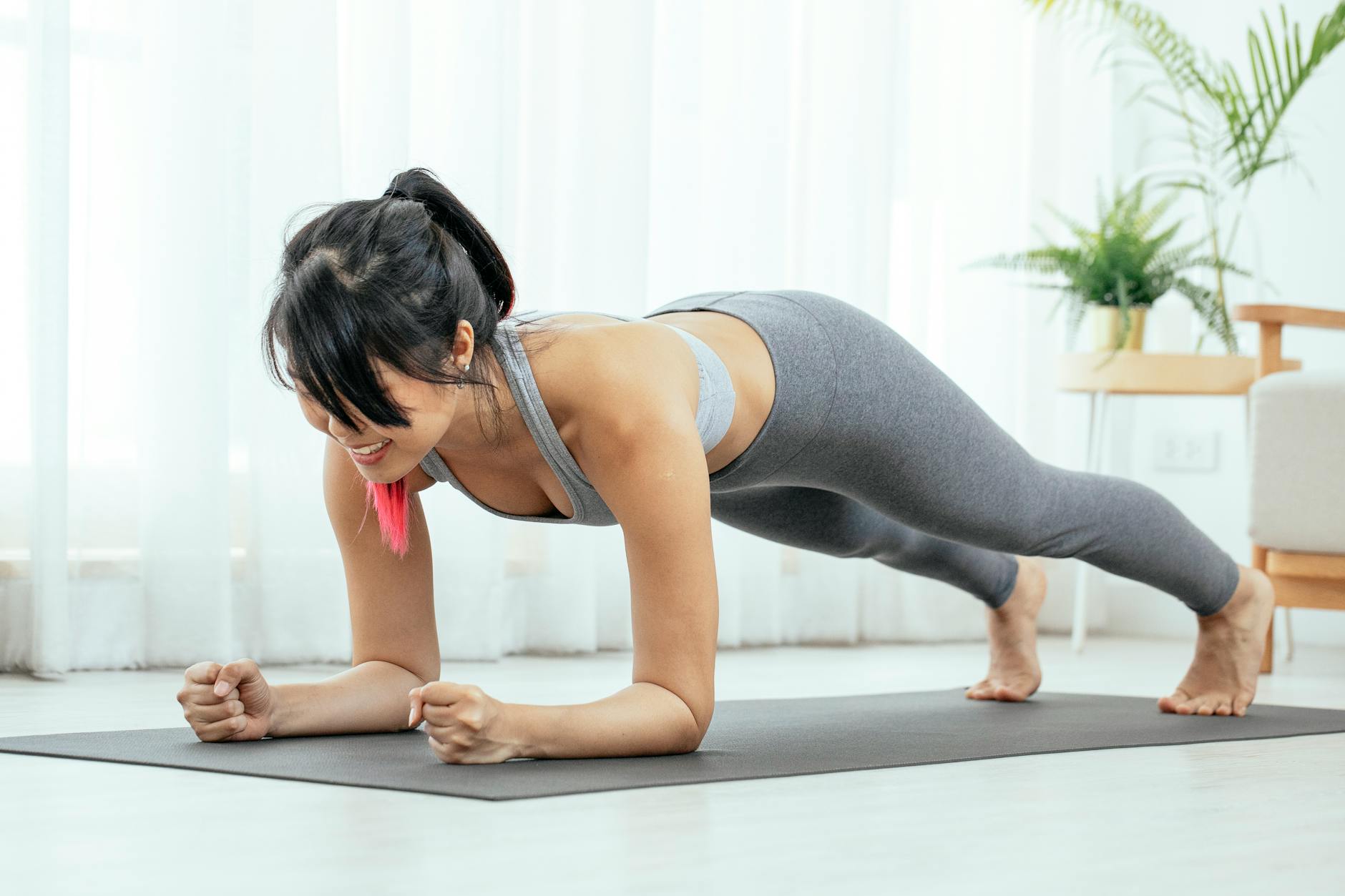
8. Plank Hold (1 Minute)
Start in a forearm plank position with your elbows under your shoulders and your legs extended. Engage your core, glutes, and thighs to keep your body in a straight line, breathing evenly while holding steady for the full minute.
How to Keep Progressing Without Adding Weight
One real challenge with bodyweight training is that your body eventually adapts, and the same routine that once felt hard starts to feel easier. The good news is you don’t need external weight to keep progressing; you simply need to apply progressive overload differently.
Research on strength training consistently shows that gradually increasing the challenge placed on your muscles, whether through added resistance, volume, or difficulty, is what actually drives continued strength and muscle gains over time. ² With bodyweight exercises specifically, you can apply this principle several ways: slow down your tempo, taking 3 to 4 seconds to lower into each rep rather than moving quickly; add pauses at the hardest point of a movement, like holding at the bottom of a squat for 2 seconds; increase your total reps or circuit rounds gradually over several weeks; or progress to harder variations, like moving from a modified push-up to a full one, or from a regular squat to a single-leg variation.
Training each major muscle group at least twice a week tends to produce meaningfully better results than training it only once, so structuring your week around 3 to 4 sessions of this circuit is a reasonable target once you’ve built some initial consistency. ³
Track your workouts in a simple notebook or app, noting how many rounds you completed and how each exercise felt. This small habit makes it much easier to notice when you’re genuinely ready to progress, rather than guessing based on how a single session felt.
Nutrition Support for Muscle Growth
Exercise provides the stimulus for muscle growth, but your body needs the right building blocks to actually repair and build new tissue. Protein is the most important nutrient here.
Research consistently shows that adequate protein intake significantly supports muscle growth and strength gains from resistance training, bodyweight training included. ⁴ Aim for roughly 0.7 to 1 gram of protein per pound of body weight daily, spread across your meals, with sources like eggs, chicken, fish, beans, and Greek yogurt.
Don’t overlook carbohydrates and healthy fats either. Carbs fuel the actual effort you put into each workout, while healthy fats support hormone production that plays a role in muscle repair. A balanced plate built around protein, whole grains or starchy vegetables, and healthy fats gives your body everything it needs to actually use the training stimulus you’re providing.
Recovery Matters Just as Much as the Workout
Your muscles don’t actually grow during the workout itself; they grow during the rest and repair that happens afterward. Skipping recovery consistently undermines the very results you’re working toward.
Sleep plays an outsized role here. Research shows that even short-term sleep restriction disrupts the hormones your body needs for recovery, leaving you both more fatigued and hungrier the next day. ⁵ Aim for 7 to 9 hours of quality sleep, and give major muscle groups at least one full rest day between hard sessions.
Mild to moderate soreness in the 24 to 48 hours after a new or harder workout is a completely normal part of this process, and it typically fades within a few days as your body adapts. ⁶ Sharp, one-sided pain that lingers or worsens is a different signal, and warrants easing off and possibly seeking guidance from a healthcare provider.
Why This Approach Genuinely Works
None of this requires a gym, expensive equipment, or a complicated program to deliver real results. Regular resistance training, including well-structured bodyweight training, is genuinely linked to meaningfully better long-term health outcomes, extending well beyond how you look. ⁷
Give this routine 4 to 6 weeks of consistent effort, applying the progression strategies above as the circuit starts to feel easier, before judging your results. Most people notice real improvements in strength and how their clothes fit within this timeframe when training and nutrition are both reasonably consistent.
The Bottom Line
Your home can genuinely be your best gym. You don’t need a membership, fancy gear, or a trainer standing over you to get in real shape; you need a consistent bodyweight routine, a way to keep progressively challenging yourself, adequate protein, and enough sleep to actually recover.
Clear some space, commit to this circuit a few times a week, and trust that consistent effort with genuine progression will deliver real strength and muscle gains over the following weeks and months, no dumbbells required.
References
¹ Aerenhouts D, D’Hondt E. (2020). Using machines or free weights for resistance training in novice males? A randomized parallel trial. International Journal of Environmental Research and Public Health. https://pubmed.ncbi.nlm.nih.gov/33114782/
² Schoenfeld BJ, Ogborn D, Krieger JW. (2017). Dose-response relationship between weekly resistance training volume and increases in muscle mass: a systematic review and meta-analysis. Journal of Sports Sciences. https://pubmed.ncbi.nlm.nih.gov/27433992/
³ Schoenfeld BJ, Ogborn D, Krieger JW. (2016). Effects of resistance training frequency on measures of muscle hypertrophy: a systematic review and meta-analysis. Sports Medicine. https://pubmed.ncbi.nlm.nih.gov/27102172/
⁴ Morton RW, Murphy KT, McKellar SR, et al. (2018). A systematic review, meta-analysis and meta-regression of the effect of protein supplementation on resistance training-induced gains in muscle mass and strength in healthy adults. British Journal of Sports Medicine. https://pubmed.ncbi.nlm.nih.gov/28698222/
⁵ Spiegel K, Tasali E, Penev P, Van Cauter E. (2004). Brief communication: sleep curtailment in healthy young men is associated with decreased leptin levels, elevated ghrelin levels, and increased hunger and appetite. Annals of Internal Medicine. https://pubmed.ncbi.nlm.nih.gov/15583226/
⁶ Cheung K, Hume PA, Maxwell L. (2003). Delayed onset muscle soreness: treatment strategies and performance factors. Sports Medicine. https://pubmed.ncbi.nlm.nih.gov/12617692/
⁷ Shailendra P, Baldock KL, Li LSK, Gorzelitz JS, Matthews CE, Trabert B, Bennie JA, Boyle T. (2022). Resistance training and mortality risk: a systematic review and meta-analysis. American Journal of Preventive Medicine. https://pubmed.ncbi.nlm.nih.gov/35599175/
Health Disclaimer: This article is for general information only and is not medical advice. Talk to a doctor before starting a new exercise program, especially if you have a chronic health condition, joint issues, or have been inactive for an extended period. Stop and consult a healthcare provider if you experience sharp pain, dizziness, or unusual discomfort during exercise.
Leave a Reply