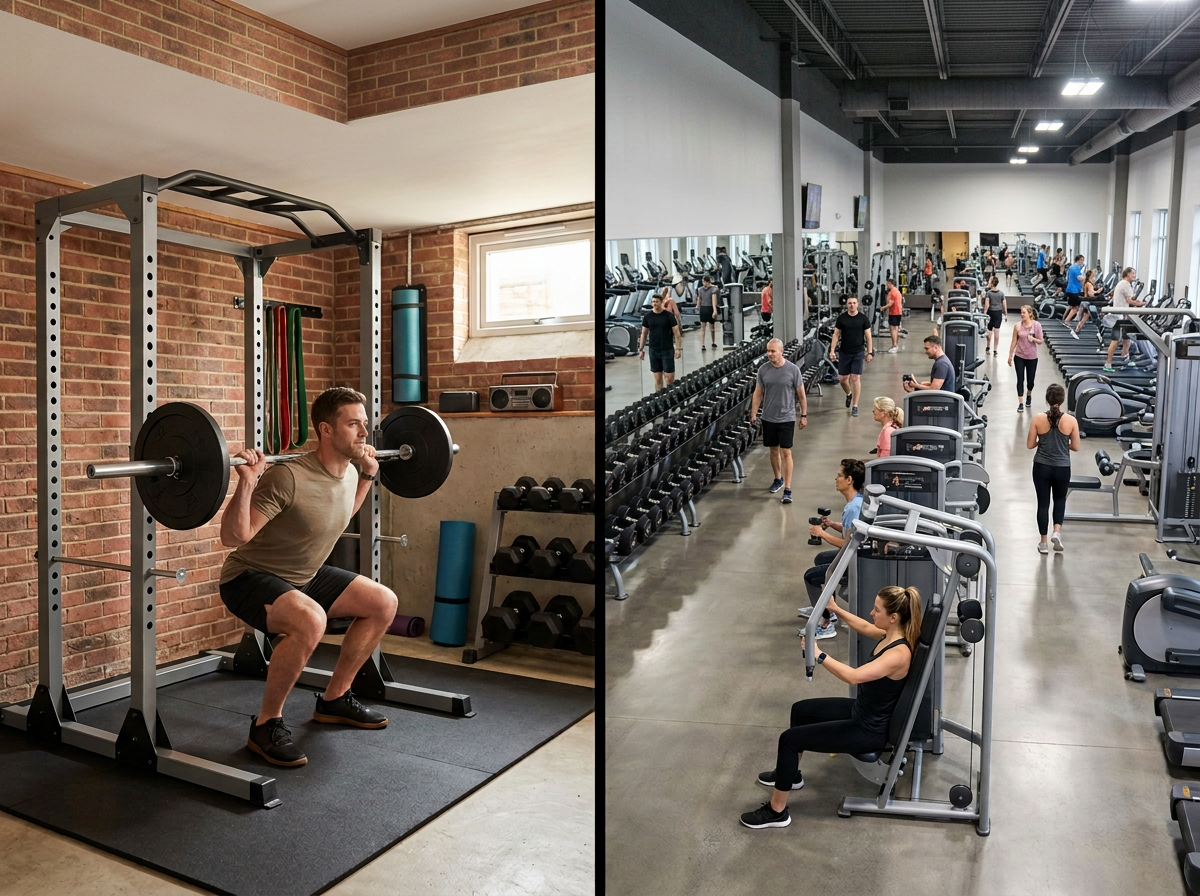
- Home Gym vs. Gym Membership: 5-Year Cost at a Glance
- The Real 5-Year Cost of a Gym Membership
- The Real 5-Year Cost of a Home Gym
- Three Home Gym Budgets Compared
- Cost Per Workout: The More Useful Comparison
- Home Gym vs. Gym Membership: Beyond the Money
- What About Equipment Depreciation and Resale Value?
- When Does a Home Gym Become Cheaper?
- Home Gym vs. Gym Membership: Which Is Better for Different People?
- How to Build a Home Gym Without Overspending
- Is a Home Gym Worth It?
- FAQ
- Final Verdict
A $40-a-month gym membership sounds cheap. But stretch that number out over five years, add in enrollment fees, gas money, and the gear you’ll still want to buy anyway, and the math looks a lot different than the sticker price suggests.
This guide breaks down the real 5-year cost of a gym membership versus a home gym, at budget, mid-range, and premium levels, so you can see when each option actually pays off rather than comparing monthly fees alone.
Quick answer: For people who train consistently (3 or more times a week), a home gym almost always wins on cost within 2 to 4 years, even at a mid-range budget. For occasional exercisers, a basic gym membership is usually still cheaper, since underused equipment is a sunk cost with no real savings behind it. We’ll walk through exactly why below.
Before you build a home setup, it helps to actually have a workout plan ready to go, since equipment without a program is just furniture. Our guide to ChatGPT prompts for workout planning is a genuinely useful, free way to build a real training plan around whatever equipment you end up choosing.
Home Gym vs. Gym Membership: 5-Year Cost at a Glance

| Typical Gym Membership | Budget Home Gym | Mid-Range Home Gym | Premium Home Gym | |
|---|---|---|---|---|
| Upfront cost | $0–$50 (enrollment) | $500–$1,000 | $2,000–$5,000 | $5,000–$15,000+ |
| Monthly/annual cost | $15–$245+/mo | ~$0–$10/mo | ~$0–$35/mo | ~$40–$60/mo |
| Maintenance | None (facility’s problem) | Minimal | Occasional part replacement | Regular upkeep, warranties help |
| Accessories | Often extra (locks, gear) | Included in budget | Included in budget | Included in budget |
| 5-year total | ~$1,150–$13,700 | ~$750–$1,100 | ~$3,600–$6,500 | ~$10,000–$18,500 |
| Approx. cost per workout* | Varies widely by actual use | ~$1–$2 | ~$1.50–$4 | ~$3–$8 |
*Assumes consistent use (3x/week); see the cost-per-workout section below for why this number matters more than the total.
The Real 5-Year Cost of a Gym Membership

Monthly membership fees vary enormously. Budget chains like Planet Fitness charge $15 to $25 per month for their base tier, plus a roughly $49 annual fee. Mid-range, full-service gyms like LA Fitness typically run $30 to $50 per month. Premium clubs are a different world entirely, Equinox memberships range from about $205 to $415 per month depending on access level and location. [note1]
Initiation, enrollment, and annual fees add up fast. Even budget gyms charge annual maintenance fees, and enrollment fees can range from $0 (during a promotion) to $60 or more. Premium clubs often add a separate initiation fee on top of the monthly rate.
Hidden gym costs most people forget:
- Cancellation fees, which can be substantial at contract-based gyms
- Transportation and fuel for the commute, twice per session
- Parking, especially at urban or premium locations
- Workout clothing and gear, which you’d need regardless, but many people buy more when gym-going feels like a “going out” activity
- Paid classes or amenities not included in base membership
- The actual time spent commuting, which isn’t a dollar cost but is a real cost against your week
A realistic 5-year example:
- At a budget gym ($20/month average plus the $49 annual fee), five years runs about $1,449.
- At a mid-range gym ($40/month plus a modest annual fee), five years runs closer to $2,600.
- At a premium club ($220/month average), five years runs roughly $13,200, before even counting an initiation fee.
- Small monthly numbers compound into serious money over 60 months, which is exactly the trap flat-fee gym memberships are built around.
There’s real research behind that trap. A well-known study of gym members found that people who chose a flat monthly membership over $70 attended, on average, just 4.3 times per month, and paid more than $17 per visit when a $10-per-visit pass was available the entire time. On average, these members left about $600 in savings on the table over the course of their membership.[1] The core issue isn’t that gyms are a bad deal for everyone, it’s that most people significantly overestimate how often they’ll actually go.
The Real 5-Year Cost of a Home Gym

Initial equipment investment varies by what you actually need:
- Dumbbells or kettlebells: $70 to $900+ depending on whether you buy fixed weights or an adjustable set
- An adjustable bench: $100 to $300 for solid quality, up to $900 for premium models
- A power rack: $200 to $1,000+ depending on gauge steel and features
- A barbell and weight plates: Roughly $300 to $600 for a complete set, with cast iron running $0.75 to $1.50 per pound and rubber-coated plates $1.50 to $2.50 per pound
- Cardio equipment: $1,000 to $3,500+ for a quality treadmill or bike
- Cable machines or functional trainers: $1,500 to $4,000+
- Smart fitness equipment (connected bikes, treadmills, mirrors): $1,500 to $6,000+ per unit
For example, a solid starting adjustable dumbbell set like the Yes4All Adjustable Dumbbell Set runs around $70 to $100, a realistic mid-range power rack like the Titan Fitness T-3 Series Power Rack runs $300 to $450, and stepping up to premium smart cardio equipment like the NordicTrack Commercial 1750 Treadmill runs closer to $2,000 to $2,500.
Ongoing costs are real but modest by comparison:
- Replacement equipment (grips wear out, cables fray) is occasional, not constant
- Maintenance is minimal for iron and steel; more relevant for cardio machines with motors
- Flooring (rubber mats or tiles) is a one-time cost, typically $150 to $500 for a home gym-sized area
- Electricity is negligible unless you’re running a treadmill or AC unit constantly
- Fitness apps and streaming workout programs, if you use smart equipment, typically run $10 to $40 per month per platform
The cost people forget: space itself. A garage or basement conversion is essentially free if that space wasn’t otherwise being used. A spare bedroom is a different story, that’s square footage with real value, whether you’d rent it out, use it as an office, or just enjoy having it. If dedicating a room to a home gym means giving up usable living space, factor that opportunity cost into your decision honestly, even though it doesn’t show up on a receipt.
Three Home Gym Budgets Compared

Budget Home Gym: $500–$1,000
Best equipment categories: adjustable dumbbells, resistance bands, a yoga mat, and possibly a pull-up bar. This tier is ideal for beginners, apartment dwellers, or anyone testing whether a home gym habit will actually stick before investing more.
Expected lifespan: 5+ years for the core equipment (dumbbells and bands rarely fail).
5-year cost: Roughly $750 to $1,100 including minor replacements.
Mid-Range Home Gym: $2,000–$5,000
This tier typically includes a power rack, barbell, a real plate set, an adjustable bench, and either a cardio machine or a rowing machine. It’s the best value range for most people who plan to train consistently for years, since it covers the vast majority of strength and cardio needs without commercial-grade pricing.
5-year cost: Roughly $3,600 to $6,500, factoring in an occasional cardio subscription and minor part replacement.
Premium Home Gym: $5,000–$15,000+
This tier includes smart, connected equipment (a Peloton-style bike or treadmill, a functional trainer, or a full commercial-grade rack system) and often stacks multiple ongoing subscriptions on top of the hardware. Premium equipment makes financial sense mainly for households with multiple regular users, since the cost splits across more people and more workouts.
5-year cost: Roughly $10,000 to $18,500, including subscriptions.
Cost Per Workout: The More Useful Comparison
Total cost alone can be misleading, since it ignores how often you actually use what you paid for. Cost per workout is the number that actually matters.
At 2 workouts per week (about 520 workouts over 5 years): A budget gym membership (~$1,300 total) works out to about $2.50 per workout. A budget home gym (~$900 total) works out to about $1.73 per workout.
At 3 workouts per week (about 780 workouts over 5 years): The same budget gym membership drops to about $1.67 per workout, and the budget home gym drops to about $1.15 per workout. A mid-range home gym (~$5,000 total) comes in around $6.41 at this frequency, still expensive per session at low volume, but that number keeps falling the more you use it.
At 5 workouts per week (about 1,300 workouts over 5 years): A mid-range home gym (~$5,000) drops to roughly $3.85 per workout, often cheaper than even a budget gym membership used at the same frequency once fuel, parking, and time are factored in.
The takeaway: consistency, not total spending, is what actually determines whether either option was a good financial decision. The exact same home gym can be a fantastic value or a genuinely bad one depending entirely on how often it gets used, and the research on gym attendance suggests most people are overconfident about how consistent they’ll actually be.[2]
Home Gym vs. Gym Membership: Beyond the Money

Advantages of a Home Gym
- Total convenience, no travel time required
- No commute, which research identifies as a real, measurable barrier to consistent exercise[3]
- Complete privacy while training
- 24/7 access on your own schedule
- No waiting for equipment during peak hours
- Generally easier to maintain a consistent routine when the barrier to starting is simply walking into the next room
Advantages of a Gym Membership
- Far greater equipment variety, especially specialty machines
- More total space to move, especially for group activities
- Access to group classes and structured programming
- A built-in community and social environment
- Easier access to personal training
- No need to research, assemble, or maintain equipment yourself
What About Equipment Depreciation and Resale Value?
Home gym equipment isn’t necessarily a 100% sunk cost the way a gym membership fee is. Durable equipment (iron plates, steel racks, barbells) holds resale value remarkably well, since there’s little to actually wear out. Electronics and smart equipment depreciate much faster, similar to any consumer tech, and can lose 40% to 60% of their value within a few years as newer models replace them.
Example: A $3,000 mixed home gym (rack, bench, plates, and a basic cardio machine) might retain 40% to 60% of its value in resale after several years of moderate use, meaning $1,200 to $1,800 back if you ever sell it. That effectively drops your real 5-year cost to somewhere between $1,200 and $1,800, dramatically better than the sticker price alone suggests. Gym memberships, by contrast, return exactly $0 in resale value no matter how little you used them.
When Does a Home Gym Become Cheaper?
Break-even depends heavily on which gym tier you’re comparing against.
Against a $40/month gym ($480/year):
- A $1,000 home gym breaks even in about 2.1 years
- A $3,000 home gym breaks even in about 6.25 years
- A $5,000 home gym breaks even in just over 10 years
Against a $60/month gym ($720/year):
- A $1,000 home gym breaks even in about 1.4 years
- A $3,000 home gym breaks even in about 4.2 years
- A $5,000 home gym breaks even in about 6.9 years
Against a $100/month gym ($1,200/year):
- A $1,000 home gym breaks even in under 1 year
- A $3,000 home gym breaks even in 2.5 years
- A $5,000 home gym breaks even in about 4.2 years
The higher your gym membership tier, the faster a home gym pays for itself, and frequency of use shifts these numbers further in the home gym’s favor, since a membership you actually use every day extracts real value, while equipment you actually use every day pays for itself that much faster too.
Home Gym vs. Gym Membership: Which Is Better for Different People?
| Person | Better Choice | Why |
|---|---|---|
| Beginner | Gym | Low upfront commitment while you figure out what you actually enjoy |
| Occasional exerciser | Gym | Avoids equipment sitting unused, which erases any potential savings |
| Frequent lifter | Home gym | Convenience plus strong long-term value |
| Busy parent | Home gym | Eliminates the commute, the single biggest barrier to consistency |
| Social exerciser | Gym | Community and classes are hard to replicate at home |
| Strength-focused lifter | Home gym | Direct equipment access without waiting or travel |
| Cardio enthusiast | Depends | Compare specific equipment costs (a treadmill isn’t cheap) against membership |
| Apartment dweller | Gym | Real space constraints often rule out a full home setup |
How to Build a Home Gym Without Overspending
- Start with versatile equipment. Adjustable dumbbells, a bench, and resistance bands cover far more exercises than any single specialty machine.
- Buy used where it makes sense. Iron, steel racks, and barbells hold up well used; electronics and smart equipment are riskier secondhand.
- Avoid buying equipment for exercises you rarely perform. A leg press machine sitting unused is the same mistake as an unused gym membership, just with a bigger price tag.
- Prioritize rack, bench, and weights before specialty machines. These three cover the widest range of effective strength training on their own.
- Add equipment gradually. Building out a home gym over 12 to 18 months, adding pieces as your training actually demands them, avoids overbuying gear you’ll never touch.
- Consider adjustable equipment to save both space and money, since one adjustable dumbbell set can replace what would otherwise be five or six pairs of fixed weights.
- Calculate cost per expected use before buying anything new. If you genuinely can’t picture using a piece of equipment at least once a week, it’s probably not worth the money yet.
Is a Home Gym Worth It?
The honest answer depends on four things: your budget, your realistic workout frequency, your available space, and how much you value convenience versus community and variety.
The cheapest option upfront isn’t always the best value. A $15-a-month gym membership that goes unused for years costs more, in both money and missed training, than a modest home gym you actually use consistently.
A simple 3-question framework:
- Will I realistically work out at least 2 to 3 times per week for the next several years? (If no, a gym is probably the safer financial bet.)
- Do I have the space, even a corner of a room, to dedicate to equipment? (If no, that constraint may decide this for you regardless of cost.)
- Do I value privacy and convenience more than community, classes, and equipment variety? (This is a genuine preference question, not just a financial one.)
FAQ
Is a home gym cheaper than a gym membership? Over 5 years, yes for most consistent exercisers, especially compared to mid-range or premium gym memberships. For occasional exercisers, a basic gym membership is often still cheaper in total.
How much does a home gym cost? Budget setups run $500 to $1,000, mid-range setups run $2,000 to $5,000, and premium setups with smart, connected equipment run $5,000 to $15,000 or more.
How much does a gym membership cost over 5 years? Roughly $1,150 to $1,300 for a budget gym, $2,600 to $3,000 for a mid-range gym, and $13,000 or more for a premium club like Equinox.
How long does it take for a home gym to pay for itself? It depends on the gym tier you’re comparing against and how much you spend on equipment, but a modest $1,000 to $3,000 home gym typically breaks even against a mid-range membership within 2 to 5 years.
Is it worth buying a home gym? For anyone who trains consistently and has the space, generally yes, both financially and for convenience. For occasional exercisers, a gym membership remains the lower-risk choice.
What is the cheapest way to build a home gym? Adjustable dumbbells, resistance bands, a yoga mat, and bodyweight training cover a genuinely complete workout for under $200, and can be expanded gradually from there.
Is a home gym worth it for beginners? It can be, but many beginners benefit from a low-commitment gym membership first, both to build the habit and to figure out what kind of training they actually enjoy before investing in equipment.
How much should I spend on a home gym? Match your spending to your realistic training frequency and goals; roughly $500 to $1,000 for casual, general fitness, and $2,000 to $5,000 for serious, varied strength and cardio training most people will actually use for years.
Final Verdict
Over a 5-year horizon, the numbers are fairly clear: for anyone training 3 or more times per week, a home gym, even a modest one, tends to beat a mid-range or premium gym membership on total cost, often significantly. For occasional exercisers, a basic gym membership remains the safer, lower-risk option, since unused equipment provides zero return no matter how good a deal it looked like at checkout.
The real break-even point isn’t really about the equipment tier you choose, it’s about honestly predicting your own consistency. Research on gym membership behavior consistently shows people are overconfident about how often they’ll actually show up.[1][2] Be honest with yourself about that tendency before you commit to either option, and the financial decision becomes a lot clearer.
References
[^1]: DellaVigna S, Malmendier U. “Paying Not to Go to the Gym.” American Economic Review. 2006;96(3):694-719. Read the study
[^2]: “Can financial incentives aid habit formation? Evidence from a randomized controlled trial of gym attendance incentives.” Found substantial overconfidence among new gym members about how often they would actually visit. Read the study on PMC
[^3]: Centers for Disease Control and Prevention. “Overcoming Barriers to Physical Activity.” Identifies convenience and time as major, well-documented barriers to consistent exercise. Read the CDC guidance
[^note1]: Gym membership pricing data (Planet Fitness, LA Fitness, Equinox) reflects publicly available pricing as of mid-2026 and varies by location and promotion; verify current rates directly with each gym before making a decision.
Additional context on the health and economic cost of physical inactivity comes from the CDC’s Active People, Healthy Nation initiative, which estimates inadequate physical activity is associated with $192 billion in annual U.S. health care costs. Available at cdc.gov/active-people-healthy-nation
This article is for general informational and educational purposes only and is not financial or medical advice. Talk with a doctor before starting a new exercise program, especially if you have an existing health condition, injury, or concern, whether you train at a gym or at home. All costs referenced in this article are estimates based on publicly available pricing as of the time of writing; actual gym membership fees, equipment prices, and financing terms vary by location, brand, promotion, and market conditions, and change frequently. Always verify current pricing directly with gyms and retailers before making a purchasing decision.
Leave a Reply