- The Problem with Most Cardio for Painful Knees
- Knee-Friendly Cardio Option 1: Water Aerobics and Pool Walking — The Lowest-Impact Starting Point
- Knee-Friendly Cardio Option 2: Recumbent Cycling — Knee-Friendly Cardio You Can Do at Home
- Knee-Friendly Cardio Option 3: Seated and Standing Low-Impact Marching
- Knee-Friendly Cardio Option 4: Tai Chi for Cardiovascular Health and Joint Mobility
- Knee-Friendly Cardio Option 5: Walking — Modified for Knee-Painful Joints
- How to Choose the Right Option for Your Knees
- When to Stop and Seek Medical Advice
- The Right Cardio Protects Your Knees — It Doesn't Damage Them
Most cardio advice is written for people with healthy knees. It assumes you can jog, do jumping jacks, or climb a stair machine for 30 minutes without your joints filing a formal complaint. For the millions of adults over 60 living with knee osteoarthritis, chronic joint pain, or post-surgical limitations, that advice isn’t just unhelpful — it can actively keep people from exercising at all.
The logic is understandable: if walking hurts and running is out of the question, it’s easy to conclude that cardio isn’t an option. That conclusion is wrong, and it’s costly. Inactivity accelerates the very joint degeneration people are trying to protect themselves from. The synovial fluid that lubricates knee cartilage is distributed through movement — a sedentary knee is a stiffer, more painful knee over time.
The question isn’t whether you can do cardio with joint pain. It’s which cardio is appropriate for your specific joints, at your specific level of inflammation, and how to build a routine that increases fitness without increasing pain. This guide answers all three.

The Problem with Most Cardio for Painful Knees
Cardio exercise falls on a spectrum of joint impact — from high-impact (running, jumping, aerobic dance) to moderate-impact (brisk walking on hard surfaces, elliptical with heavy resistance) to low-impact (swimming, cycling, seated movement) to zero-impact (water-suspended exercise, chair-based movement).
For seniors with knee joint pain, the distinction matters enormously. High-impact activities load the knee joint with forces equal to three to six times bodyweight with each footstrike. For a person with thinning cartilage or active inflammation, that force is the problem — not the cardio itself.
Research consistently shows that low-impact aerobic exercise reduces knee pain, improves function, and slows the progression of osteoarthritis — often more effectively than rest.1 The key is matching the impact level to the current joint condition: exercising through appropriate discomfort (mild stiffness that eases as you warm up) versus exercising through pain signals that indicate damage (sharp pain, significant swelling after sessions, warmth in the joint).
The five options below are ranked from lowest to higher impact within the low-impact category, so you can start where your joints allow and progress from there.
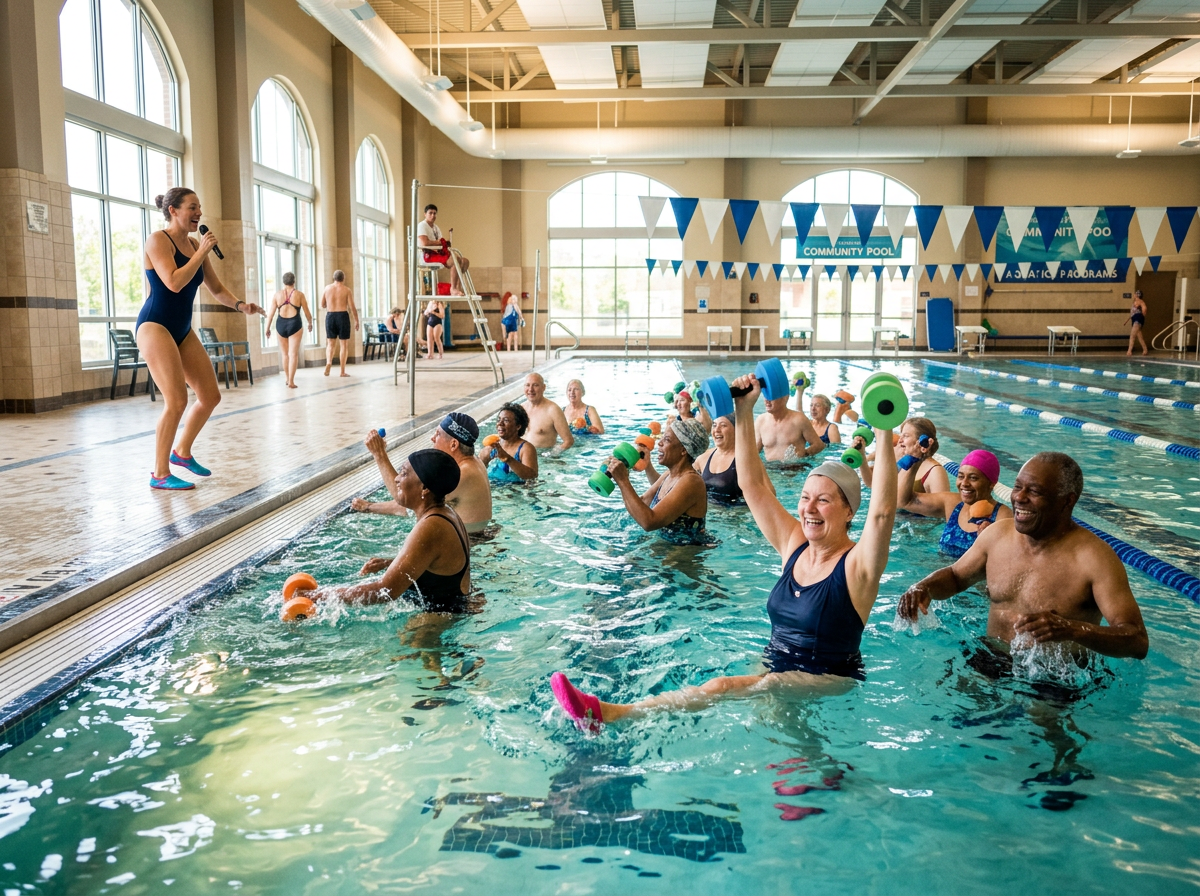
Knee-Friendly Cardio Option 1: Water Aerobics and Pool Walking — The Lowest-Impact Starting Point
Water exercise sits at the top of this list for one simple reason: buoyancy. When you’re submerged to chest height, the water supports approximately 75% of your body weight, which means the compressive force on your knee joints drops to roughly 25% of what it would be on land. You can walk, step, march, and move your legs through a full range of motion with almost no joint loading — while your cardiovascular system works just as hard as it would during land-based movement at the same intensity.2
What water aerobics does for seniors with knee pain:
- Builds cardiovascular fitness without joint compression
- Allows full range-of-motion leg movement that land exercise often cannot match
- The water’s hydrostatic pressure actually reduces swelling in inflamed joints during and after exercise
- The resistance of moving through water strengthens the muscles around the knee without impact
- Works for people who cannot bear full weight on land due to post-surgical recovery or severe arthritis
Getting started with water exercise:
Most community pools and YMCAs offer senior water aerobics classes — a structured, social option that provides guided instruction and appropriate pacing. If you prefer independent pool sessions, pool walking is the simplest starting point: walk across the pool in chest-deep water, focusing on a full heel-to-toe stride pattern. Start with 10–15 minutes and build by 5 minutes each week.
Water shoes provide grip on slippery pool decks and pool floors while adding a small amount of water resistance during movement. Speedo Surfwalker Pro Water Shoes have a drainage sole to shed water quickly, non-slip grip designed specifically for wet surfaces, and a snug fit that stays on during pool walking without slipping — a practical safety addition for anyone exercising in and around pool environments.
What to watch for: Mild muscle fatigue and light breathlessness are expected. Stop if you feel dizziness, chest tightness, or any sharp joint pain.
Knee-Friendly Cardio Option 2: Recumbent Cycling — Knee-Friendly Cardio You Can Do at Home
A recumbent bike positions you in a reclined seat with your legs extending forward rather than downward. This changes the mechanics of cycling in two ways that matter for knee health: it distributes weight across the back rather than the knee joint, and it places the hip in a more open position that reduces the compressive demand on the patella (kneecap) during the pedaling motion.
For seniors with anterior knee pain — the aching behind or around the kneecap that’s common with osteoarthritis and patellar tracking issues — recumbent cycling is frequently recommended over upright cycling because the reduced knee flexion angle puts less strain on the patellar tendon and the joint surface beneath it.
Benefits of recumbent cycling for seniors:
- Low joint impact with cardiovascular benefit equivalent to upright cycling at the same resistance
- Supported back position eliminates lower back and wrist strain common with upright bikes
- Adjustable resistance allows you to start at zero load and progress gradually
- Can be done at home, removing weather and transportation barriers that affect consistency
- Seat height and distance are easy to adjust for full leg extension at the bottom of the pedal stroke
Setting up your recumbent bike correctly:
The single most important adjustment is seat distance. At the bottom of the pedal stroke, your knee should have a slight bend — roughly 10 to 15 degrees — not fully extended and not deeply bent. A knee that fully locks out at the bottom of the stroke or bends beyond 90 degrees at the top places unnecessary stress on the joint. Adjust the seat until you find that range and mark the position.
Start with 10–15 minutes at low resistance, three times per week. Build duration before adding resistance. The goal in the first four weeks is consistency and joint adaptation, not cardiovascular intensity.
Schwinn 230 Recumbent Exercise Bike is one of the most widely used home recumbent bikes in the senior fitness category — 22 resistance levels, a step-through frame that’s easy to mount without lifting your leg high, a clear display for tracking time and heart rate, and a stable wide base that doesn’t require anchoring to the floor. The seat adjusts across a wide range to accommodate different leg lengths, and the pedals have adjustable straps to keep feet secure without requiring cycling shoes.
Knee-Friendly Cardio Option 3: Seated and Standing Low-Impact Marching
Marching in place — lifting alternate knees while pumping the arms — is the most accessible form of cardio available to seniors with joint pain. It can be done standing (holding a chair for support if needed), seated in a sturdy chair, or alternating between both. It requires no equipment, no special environment, and can be done in any room of the house.
The reason marching works as a cardio stimulus is the same reason walking works: the repeated alternating leg lift elevates heart rate progressively, engages the hip flexors and core, and when done with active arm movement, engages the upper body enough to meaningfully increase cardiac demand.
Standing march protocol (using a chair for support):
Stand behind a sturdy chair with both hands lightly resting on the backrest. Lift your right knee to hip height (or as high as comfortable), lower it, then lift the left. March at a pace where you can feel your heart rate elevating but can still hold a short conversation. Start with 5 minutes of continuous marching. Build to 15–20 minutes over six to eight weeks.
Seated march protocol (for those who cannot safely stand for extended periods):
Sit in a sturdy chair with your feet flat on the floor and your back supported. Lift your right knee toward your chest, lower it, then lift your left. Add arm movements — swing the opposite arm forward as each knee rises. Seated marching at a brisk pace can elevate heart rate significantly, particularly for deconditioned beginners.
Making marching more effective:
- Add arm reaches overhead alternately with knee lifts to increase demand
- March to music with a steady beat — 100 to 120 beats per minute is an appropriate target pace
- Use a timer rather than counting — counting steps is distracting and reduces the consistency of movement
What to watch for: Knee pain above a 3 out of 10 during marching is a signal to switch to the seated version or reduce the height of the knee lift. Mild hip flexor fatigue is expected and normal.
Knee-Friendly Cardio Option 4: Tai Chi for Cardiovascular Health and Joint Mobility
Tai Chi is often categorized as a flexibility or balance practice, but a meaningful body of research has confirmed its cardiovascular and joint health benefits for older adults specifically. A slow, flowing Tai Chi session at moderate pace elevates heart rate to low-to-moderate aerobic zones, improves the proprioceptive awareness around the knee joint, and builds the hip and leg strength that protects the knee from compressive loading during daily activities.3
The movement characteristics of Tai Chi make it particularly appropriate for knee pain: slow transitions, never full weight-bearing on a fully bent knee, weight shifts that are deliberate and controlled, and no impact whatsoever. The gentle rotation and flexion sequences also maintain cartilage health by circulating synovial fluid through the joint without compression.
Getting started with Tai Chi:
Beginners do best with a guided class or video rather than self-teaching. Look for classes specifically labeled for seniors or beginners, as some Tai Chi styles involve deeper knee bends than others. The Yang style — the most commonly taught in Western senior programs — has relatively shallow knee positions that work well for people with joint pain.
Many senior centers, recreation departments, and community gyms offer Tai Chi specifically for older adults. If you prefer home practice, a structured DVD or streaming program provides the visual guidance that written descriptions alone cannot.
What to watch for during Tai Chi:
The slow, sustained nature of some Tai Chi postures can create prolonged low-level load on the knee — particularly the “horse stance” that appears in some styles. If any sustained position creates pain beyond mild stiffness, come out of it immediately and straighten the leg.
Knee-Friendly Cardio Option 5: Walking — Modified for Knee-Painful Joints
Walking is the most natural human movement and, done correctly on appropriate surfaces, remains one of the best low-impact cardio options for seniors with mild to moderate knee pain. The key word is “modified” — standard walking advice doesn’t account for the technique and surface adjustments that make the difference between a walk that aggravates and one that helps.
Surface matters significantly:
- Grass and packed dirt absorb impact better than concrete or asphalt
- Smooth, flat surfaces reduce lateral ankle and knee stress compared to uneven ground
- Avoid cambered roads that slope to the side for drainage — they create uneven loading across the knee
Footwear is not optional:
- Walking shoes with adequate cushioning and medial support reduce knee impact compared to worn or unsupportive footwear
- Replace walking shoes every 300–500 miles — the cushioning compresses before the outer sole visibly wears
Modified walking techniques for knee pain:
- Shorten your stride slightly — overstriding (landing with the foot far ahead of the body) increases knee impact force
- Maintain a gentle forward lean from the ankles, not the waist
- Walk at a pace where you can speak in short sentences — this approximates low-to-moderate aerobic intensity
- Use walking poles if available — they transfer a meaningful portion of lower body load to the arms and reduce knee stress on longer walks
Black Diamond Trail Ergo Cork Trekking Poles are a lightweight, collapsible option with an ergonomic cork grip that reduces hand fatigue, adjustable wrist straps, and a compact folded size that’s easy to store — appropriate for both trail walking and neighborhood walks for seniors who want to reduce knee load during longer sessions.
Start with 10 minutes on flat surfaces, three days per week. Add 2–3 minutes per week as tolerated. If swelling occurs in the knee after a walk, reduce duration before your next session and consult your physician if it persists.
How to Choose the Right Option for Your Knees
Not every option on this list suits every person with knee pain — the right choice depends on your specific diagnosis, current pain level, and access to facilities.
Use this as a starting guide:
- Severe pain or recent surgery → water aerobics or seated marching only until cleared by your physician
- Moderate pain, no surgery → recumbent cycling or water aerobics, with Tai Chi and seated marching as daily movement additions
- Mild pain, good mobility → walking (modified) or Tai Chi as primary cardio, with recumbent cycling or pool walking as alternatives
- Pain that varies day to day → keep two options in your toolkit so you can match the activity to how the joint feels that morning
The goal is to do something every day — even on difficult pain days. A 10-minute seated march on a high-pain day is better than rest for both joint health and cardiovascular consistency.
When to Stop and Seek Medical Advice
Low-impact cardio is appropriate for most knee pain — but there are signals that mean you should pause exercise and speak to a physician before continuing:
- Significant swelling in the knee joint that appears during or after a session and doesn’t resolve within 24 hours
- Sharp, stabbing pain during any movement (as distinct from the dull ache of arthritis)
- Warmth and redness in the joint — signs of active inflammation that exercise will worsen
- The knee “giving way” or feeling unstable during activity
- Pain that worsens progressively across sessions rather than remaining stable or improving
These signals don’t necessarily mean cardio is permanently off the table. They mean the current approach needs clinical evaluation before continuing.
The Right Cardio Protects Your Knees — It Doesn’t Damage Them
Knee pain is not a reason to stop moving. For most seniors with osteoarthritis or chronic joint discomfort, it’s a reason to move differently. Water aerobics, recumbent cycling, seated marching, Tai Chi, and modified walking all produce measurable cardiovascular and joint health benefits — without the compressive forces that make high-impact exercise harmful for aging knees.
Start with the option that fits your current pain level and your access to equipment or facilities. Be patient with the first four to six weeks, which is how long it typically takes for cartilage and surrounding tissue to adapt to a new movement pattern. And track how your knee feels the morning after each session — that’s your most reliable feedback signal.
Cardio is one piece of a complete fitness picture for adults over 60. Strength work, balance training, and flexibility all protect your joints in ways that cardio alone cannot. Our comprehensive free exercise and fitness guide for seniors over 60 brings all of these elements together in a practical, accessible resource built for older adults at any starting point.
This content is intended for general informational and educational purposes only. It is not intended to diagnose, treat, cure, or heal any medical condition, including osteoarthritis, joint disease, or post-surgical conditions. Joint pain in older adults can have multiple underlying causes requiring clinical evaluation and individualized treatment. Always consult a licensed physician, physical therapist, or qualified healthcare provider before beginning any new exercise program — particularly if you have been diagnosed with a joint condition, have had joint surgery, or experience significant pain, swelling, or instability in your knees or other joints.
References:
- [^1]: Fransen, M., et al. (2015). Exercise for osteoarthritis of the knee. Cochrane Database of Systematic Reviews, 1, CD004376. https://doi.org/10.1002/14651858.CD004376.pub3 ↩︎
- [^2]: Becker, B. E. (2009). Aquatic therapy: Scientific foundations and clinical rehabilitation applications. PM&R, 1(9), 859–872. https://doi.org/10.1016/j.pmrj.2009.05.017 ↩︎
- ^3]: Lauche, R., et al. (2017). A systematic review and meta-analysis of Tai Chi for osteoarthritis of the knee. Complementary Therapies in Medicine, 36, 1–11. https://doi.org/10.1016/j.ctim.2017.11.009 ↩︎
Leave a Reply