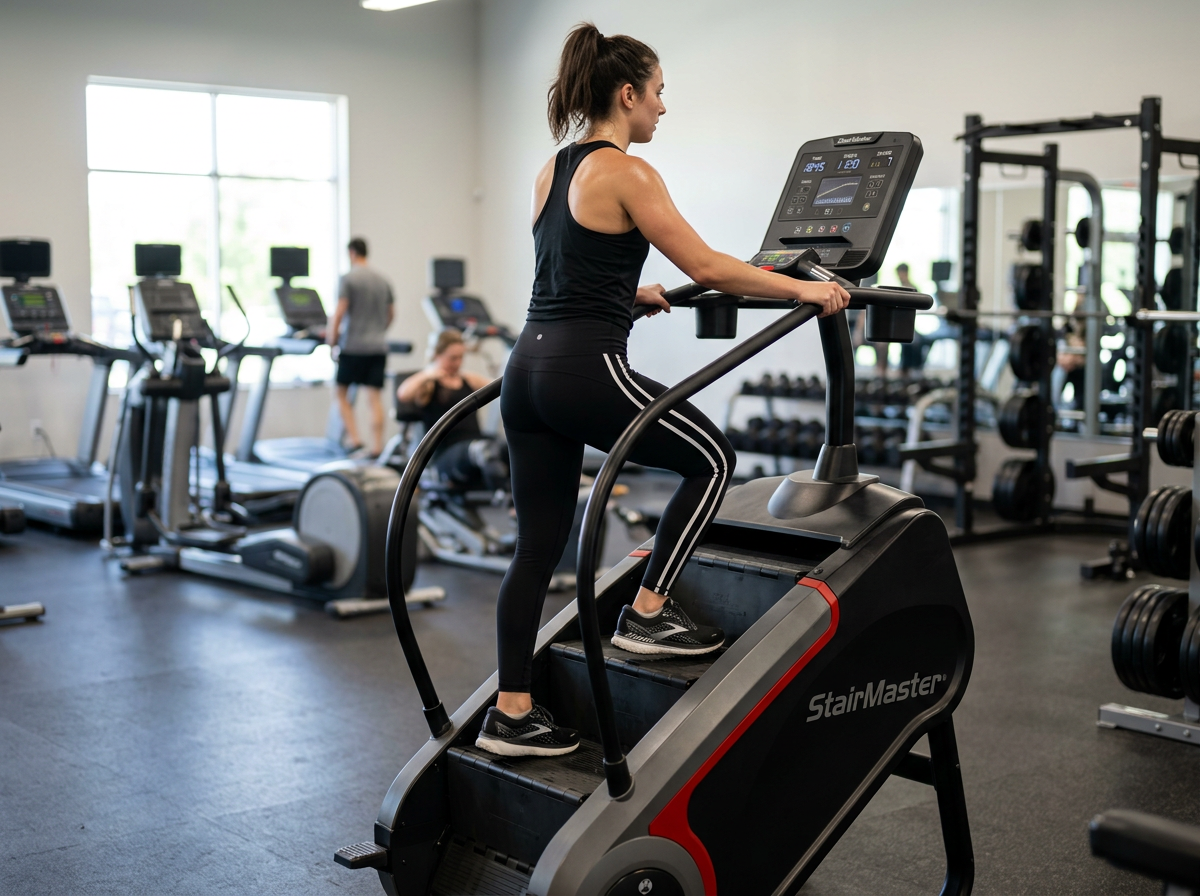
- Why Does the StairMaster Hurt My Knees?
- 1. Keep More of Your Foot on the Step
- 2. Stop Taking Extremely Deep Steps
- 3. Don't Hang on the Handrails
- 4. Reduce the Resistance and Build Back Gradually
- 5. If Your Knees Hurt, Switch to a Lower-Impact Alternative
- Should You Wear a Knee Sleeve?
- What If Your Knees Hurt After the StairMaster?
- When Should You Stop Using the StairMaster?
- Is StairMaster Hard on Your Knees?
- The Bottom Line
If your knees hurt on the StairMaster, you are not necessarily doing anything “wrong.” Stair climbing places a significant demand on the muscles and joints around the knee, and the repetitive nature of a StairMaster workout can make a small form problem much more noticeable.
So, is StairMaster hard on your knees? It can be. But the machine itself is not automatically harmful to healthy knees. The bigger issue is often how you use it: how much of your foot you place on each step, how far you bend your knees, how heavily you lean on the handles, and how quickly you increase your workout volume.
Stair ascent is particularly demanding on the knee extensors, which means your quadriceps have to work hard to repeatedly raise your body against gravity.[1] Research also shows that stair climbing can produce considerable knee loading, particularly for people who already have knee problems.[2]
If you want to keep using the machine without making your knees miserable, start by reviewing your technique. And if you’re looking for ways to make your workouts more interesting, see our guide to the 7 best StairMaster workouts.
Why Does the StairMaster Hurt My Knees?
Before changing your routine, it helps to understand what may be happening.
A StairMaster keeps your legs moving through repeated cycles of knee and hip flexion and extension. Unlike walking on a flat surface, you’re repeatedly lifting your body upward. That creates a much higher muscular demand.
One study examining stair ascent found that the knee extensors can face very high functional demands during stair negotiation.[1] Another biomechanical study found substantial quadriceps and other muscle forces during stair ascent.[3]
That doesn’t mean stair climbing is bad for your knees. It means your knees are doing real work.
Pain can become more likely when you combine that demand with:
- Excessive workout duration
- A resistance or step rate that’s too high
- Poor foot placement
- Excessive knee bend
- Repeatedly training through pain
- Fatigue-related changes in form
- Insufficient recovery between hard sessions
- Existing knee problems
The good news is that you can often reduce unnecessary stress by changing how you use the machine.
1. Keep More of Your Foot on the Step
One of the first things to check is your foot position.
Some people climb the StairMaster with only the front portion of their foot contacting the step. This can turn each repetition into a very short, repetitive movement and may make the exercise feel more like constantly pushing through your toes.
Instead, aim for a stable, controlled foot position with most of your foot supported by the step.
You don’t need to force your heel down aggressively. The goal is simply to avoid hanging your heel off the edge and repeatedly performing the movement from an unstable position.
Think about:
- Placing your foot securely on the step.
- Keeping your ankle controlled.
- Driving through the entire foot rather than just your toes.
- Allowing your knee and hip to contribute to the movement.
- Avoiding exaggerated bouncing between steps.
This is especially important when fatigue sets in. As you get tired, it becomes easy to shorten your stride and rely on the front of your foot.
A simple form test
Lower the intensity for a few minutes and ask yourself:
“Could I pause on this step and feel stable?”
If the answer is no, your pace may be too fast or your foot placement may be too aggressive.
The goal isn’t to make every repetition look perfect. It’s to create a repeatable movement pattern that you can maintain for the entire workout.
Consider your training shoes
A stable cross-training shoe can also make the machine feel more controlled. The Nike Metcon 10, for example, is designed for cross-training and emphasizes stability and mobility.
Check Price: Nike Metcon 10 on Amazon
A shoe won’t fix poor StairMaster technique, but appropriate footwear can give you a stable platform for exercise.
2. Stop Taking Extremely Deep Steps
Another common mistake is allowing the knee to bend excessively on every repetition.
The StairMaster is already demanding. You don’t need to exaggerate the movement to make the workout effective.
When you let each step become very deep, your knee may have to work through a larger range of motion while you’re repeatedly supporting your body weight.
Instead, aim for controlled steps that you can repeat without your knees feeling compressed or irritated.
You don’t necessarily have to take tiny steps, either. Find a middle ground.
Your movement should look smooth rather than exaggerated.
Try this adjustment
For your next workout:
- Reduce the step rate.
- Stand tall.
- Keep your feet stable.
- Avoid deliberately sinking extremely low between steps.
- Maintain the same movement pattern for several minutes.
- Increase intensity only if your knees remain comfortable.
This approach also makes it easier to notice whether the machine’s intensity—not necessarily your form—is the problem.
Stair climbing places a high demand on the knee extensors, so increasing step height, speed, and duration at the same time can quickly turn a manageable workout into an excessive one.[1]
3. Don’t Hang on the Handrails
The handrails are there for balance and safety. They’re not supposed to become your primary source of support.
If you’re leaning heavily on the handles, you’re changing how your body distributes the workload.
A better approach is to use the rails lightly when necessary for balance, while allowing your legs to do the work.
Try to keep:
- Your chest relatively upright.
- Your shoulders relaxed.
- Your hands lightly touching the rails when needed.
- Your weight centered over your feet.
- Your eyes forward rather than looking down at your feet.
If you need to pull hard on the handles to maintain your pace, that’s an important signal.
Reduce the speed.
Your StairMaster workout shouldn’t require you to hang from the machine to survive it.
This is one reason slower StairMaster sessions can sometimes be more productive than chasing a high step count. You want a pace you can control without your technique falling apart.
4. Reduce the Resistance and Build Back Gradually
If your knees start hurting halfway through your workout, don’t automatically assume you need a brace, supplement, or special exercise.
Your training dose may simply be too high.
A common mistake is increasing several variables at once:
- Higher step rate
- Longer workout
- More frequent sessions
- More resistance
- Less recovery
Your knees don’t care that you increased only “a little” in each category. The combined workload can become significant.
Instead, change one variable at a time.
For example, if you normally do 30 minutes at a challenging pace, temporarily reduce the intensity and see whether your symptoms settle.
Then gradually build back up.
The American Academy of Orthopaedic Surgeons recommends starting exercise gradually and increasing repetitions or resistance as strength improves. It also advises against ignoring significant pain during exercise.[4]
Use the “form before intensity” rule
If your form changes when you increase the StairMaster speed, you’re probably moving too fast for your current conditioning.
Before increasing intensity, make sure you can maintain:
- Controlled foot placement
- Smooth knee movement
- Upright posture
- Minimal reliance on the handles
- Consistent breathing
- No meaningful increase in knee pain
This is especially useful for people returning to the StairMaster after time away.
5. If Your Knees Hurt, Switch to a Lower-Impact Alternative
Sometimes the best StairMaster form fix is not using the StairMaster for a while.
That’s not failure. Cross-training is a useful way to maintain cardiovascular fitness while reducing the repeated movement that is irritating your knee.
The AAOS lists cycling and elliptical training among lower-impact options that can put less stress on the knee than higher-impact activities.[5]
Good alternatives include:
Stationary bike
Cycling is one of the simplest substitutions.
You can maintain cardiovascular conditioning without repeatedly climbing upward against gravity. Adjust the seat correctly and start with manageable resistance.
Elliptical
An elliptical provides continuous movement without the same repeated stair-climbing pattern.
It’s particularly useful if you want a cardio workout but find running, jumping, or stair climbing irritating.
Swimming
Swimming provides cardiovascular exercise with very little impact on the joints.
It’s not a direct substitute for the muscular demands of a StairMaster, but it can be an excellent recovery-day option.
Walking
Don’t overlook simple walking.
A brisk walk can provide meaningful aerobic work without forcing you to repeatedly climb hundreds of steps.
Rowing
Rowing can be another option, although it isn’t automatically knee-free. You’ll still bend and straighten your knees, so use a comfortable range of motion and avoid forcing deep knee flexion if that bothers you.
The key idea is movement tolerance. The best alternative is one you can perform consistently without worsening your symptoms.
Should You Wear a Knee Sleeve?
A knee sleeve may feel supportive or comfortable during exercise, but it shouldn’t be used as a way to push through pain.
If you want to try compression, choose a sleeve that fits properly and doesn’t create numbness, tingling, or excessive pressure.
One premium option is the Bauerfeind GenuTrain P3 Active Knee Support, which uses a contoured support design around the kneecap.
Check Price: Bauerfeind GenuTrain P3 Active on Amazon
Think of a sleeve as an optional comfort/support tool—not a solution for the underlying cause of knee pain.
If your knee hurts every time you use the StairMaster, changing the training load and getting the problem evaluated is more important than simply adding equipment.
What If Your Knees Hurt After the StairMaster?
A little muscle fatigue is different from significant joint pain.
If your knees feel irritated after a workout, give them time to recover instead of immediately repeating the same workout.
The AAOS recommends not ignoring pain during exercise and notes that significant pain can be a sign that you’ve done too much.[4]
For your next session, consider reducing:
- Duration
- Step rate
- Resistance
- Training frequency
You can also temporarily use cycling, swimming, walking, or the elliptical while your knee settles.
A recovery strategy is especially important if the pain keeps returning after every StairMaster workout.
When Should You Stop Using the StairMaster?
Not every ache means you need to stop exercising completely. But certain symptoms deserve more attention.
Stop the workout and consider getting professional advice if you experience:
- Significant or worsening pain
- Swelling
- Locking or catching
- A feeling that the knee is giving way
- Pain that changes how you walk
- Pain that continues after you stop exercising
- Symptoms that repeatedly return despite reducing your workout
The AAOS specifically advises seeking professional guidance when exercise causes pain or when you’re unsure how much exercise is appropriate.[4]
And don’t assume that persistent knee pain is simply “weak knees.” Pain around the kneecap, tendon, joint, or other structures can have different causes and may require different approaches.
Is StairMaster Hard on Your Knees?
The StairMaster can place substantial demands on your knees, but that doesn’t mean it is inherently bad for them.
Stair climbing requires significant work from the quadriceps and other muscles around the hip, knee, and ankle.[1][3] For someone with healthy, well-conditioned joints, that workload can be part of a normal exercise program.
Problems are more likely when the workload exceeds what your body currently tolerates—or when pain is repeatedly ignored.
The best approach is to make the movement easier before making it harder.
Start with good foot placement. Keep your steps controlled. Avoid hanging heavily on the rails. Reduce the speed if your form breaks down. Then build your workload gradually.
And if your knees still don’t like the StairMaster, there’s no rule saying you have to use it. Cycling and elliptical training are excellent alternatives when you need lower-impact cardio.[5]
The Bottom Line
StairMaster knee pain doesn’t automatically mean you need to give up stair climbing.
Start with these five fixes:
- Keep more of your foot on the step.
- Avoid excessively deep steps.
- Use the handrails for balance—not to support your body weight.
- Reduce intensity and increase your workload gradually.
- Switch to lower-impact cardio when your knees need a break.
The biggest mistake is trying to outwork pain. If your knees consistently hurt during StairMaster workouts, lowering the workload or changing your cardio routine may be a smarter move than simply pushing harder.
And if pain persists, worsens, or affects your normal movement, talk with a licensed healthcare professional or physical therapist rather than trying to diagnose the problem yourself.
References
[1] Reeves ND, et al. The biomechanical functional demand placed on knee and hip muscles during stair ascent and descent. Journal of Biomechanics. PubMed. View study
[2] Wei Y, et al. Stair Climbing, Genetic Predisposition, and the Risk of Hip/Knee Osteoarthritis. The Journals of Gerontology: Series A. 2024. View study
[3] Makani A, Shirazi-Adl SA, Ghezelbash F. Computational biomechanics of human knee joint in stair ascent.Computer Methods in Biomechanics and Biomedical Engineering. View study
[4] American Academy of Orthopaedic Surgeons. Knee Exercises. OrthoInfo. View guidance
[5] American Academy of Orthopaedic Surgeons. Patellofemoral Pain Syndrome. OrthoInfo. View guidance
This article is for general educational and informational purposes only. It is not medical advice and is not intended to diagnose, treat, cure, or heal any disease, injury, or medical condition. Always consult a licensed healthcare professional, physician, or physical therapist before beginning or changing an exercise program, particularly if you have persistent knee pain, an existing injury, or a medical condition.
Leave a Reply