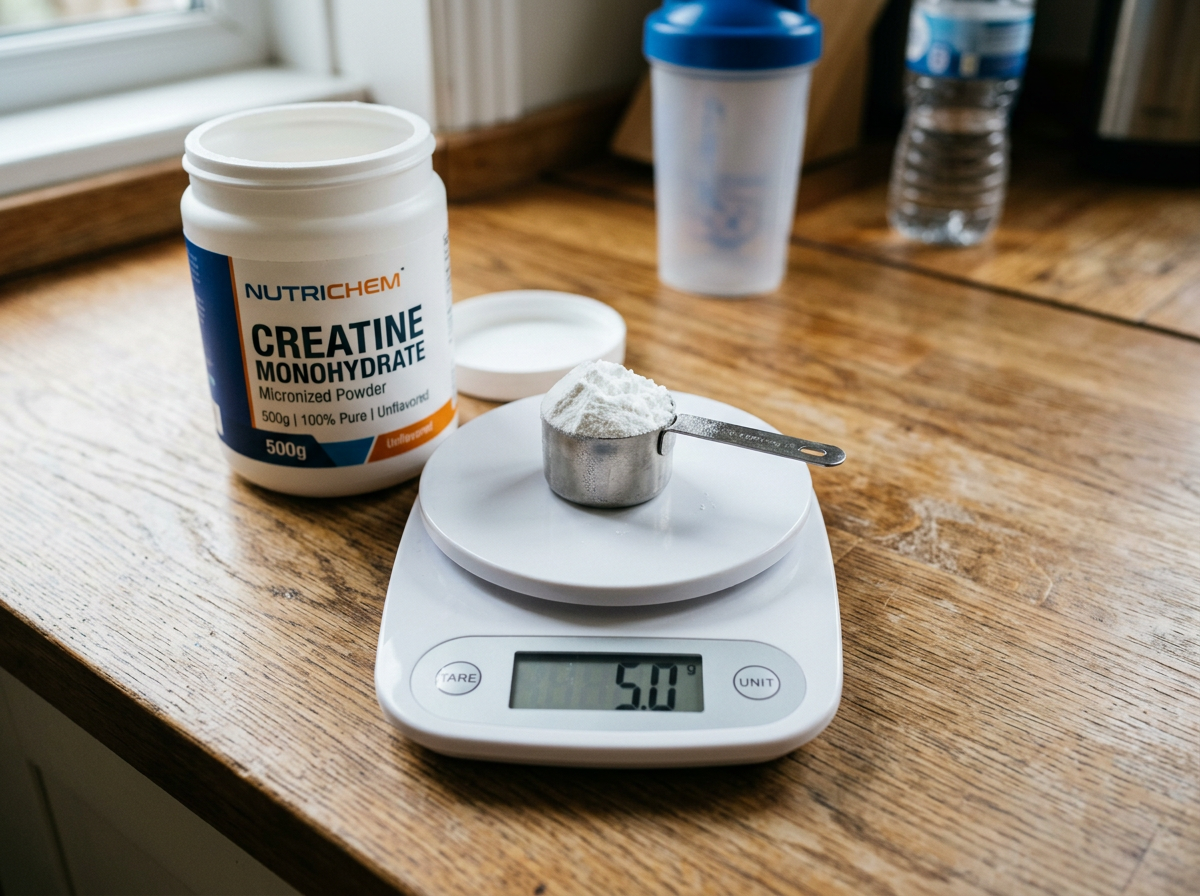
- Creatine Can Increase Scale Weight Without Increasing Body Fat
- Expect the Biggest Water-Weight Change During the First Few Weeks
- Choose Creatine Monohydrate Instead of Paying More for Fancy Forms
- Intramuscular Water Is Different From Subcutaneous Water
- Creatine Does Not Directly Turn Into Body Fat
- Don't Judge Your Progress From One Morning on the Scale
- Look at Your Waist and Training Performance Too
- A Simple 3–5 Gram Daily Dose Is Usually Enough
- Don't Stop Creatine Just Because the Scale Goes Up
- So, Is Creatine Weight Gain Fat or Water?
If you start taking creatine and suddenly weigh 2 or 3 pounds more, it is easy to assume something went wrong. You may even wonder: Is creatine weight gain fat or water?
For most people, the early increase on the scale is mainly related to water stored inside muscle cells, not an increase in body fat. Creatine pulls more water into muscle tissue as your muscles become saturated with creatine. This can make your muscles look a little fuller while increasing your body weight.
That does not mean every pound gained after starting creatine is automatically water. Your food intake, training, glycogen stores, and calorie balance still matter.
If you are gaining weight despite eating carefully and exercising, it is also worth looking at the other factors covered in our guide to why you can gain weight despite diet and exercise. And if you are new to supplementation, our guide to the best way to drink creatine covers practical tips for taking it consistently.
So, how much weight should you expect from creatine, and how can you tell whether it is water or fat?

Creatine Can Increase Scale Weight Without Increasing Body Fat
The most important thing to understand is that scale weight and body fat are not the same thing.
Your body weight includes much more than fat. It includes:
- Muscle tissue
- Body fat
- Water
- Glycogen
- Food and waste in your digestive system
- Bone and connective tissue
- Other body tissues
Creatine mainly affects the water and muscle-related parts of this equation.
When you consume creatine consistently, your muscles store more creatine. Creatine is involved in the phosphocreatine system, which helps your muscles rapidly regenerate ATP during short, intense efforts such as lifting weights, sprinting, and repeated hard sets.
As muscle creatine levels rise, water is also drawn into muscle cells. Research has found that creatine supplementation can increase total body water, with the increase occurring without a harmful shift toward extracellular fluid. [1]
That distinction matters.
Water stored inside muscle cells is not the same thing as gaining body fat.
You can therefore step on the scale and see a higher number without having gained a meaningful amount of fat.
Expect the Biggest Water-Weight Change During the First Few Weeks
The timing of your weight gain can provide a useful clue.
Creatine-related changes tend to happen relatively quickly, particularly when someone uses a loading phase. A common loading protocol uses roughly 20 grams per day, split into several doses, for about 5–7 days. After that, people commonly switch to a maintenance dose of around 3–5 grams per day.
A loading phase is not required, though.
Taking approximately 3–5 grams daily without loading can gradually saturate your muscles as well.
The important difference is the speed of the change.
With a loading phase
You may notice:
- A faster increase in scale weight
- Fuller-looking muscles
- More noticeable changes during the first week or two
- More water being stored in muscle as creatine levels rise
Without a loading phase
The changes are generally more gradual.
This can be preferable for people who are worried about seeing the scale jump suddenly.
A rapid increase shortly after starting creatine is therefore more consistent with water and increased muscle creatine stores than with newly accumulated body fat.
A useful rule is this:
A sudden 2-pound increase over several days is much more likely to be water than 2 pounds of newly created body fat.
Choose Creatine Monohydrate Instead of Paying More for Fancy Forms
If your main goal is strength, muscle growth, or improved high-intensity exercise performance, creatine monohydrate is the form with the strongest track record.
You do not need a complicated blend or an expensive proprietary formula.
Creatine monohydrate is also widely studied. The International Society of Sports Nutrition has concluded that creatine monohydrate is an effective supplement for increasing high-intensity exercise capacity and lean body mass during training. [2]
What should you look for?
A good creatine product should generally have:
- Creatine monohydrate as the main ingredient
- A simple ingredient list
- No unnecessary proprietary blend
- Clear serving information
- Third-party testing when available
- A reputable manufacturer
One well-known option is Thorne Creatine, which is a straightforward creatine monohydrate supplement: Shop Thorne Creatine Monohydrate on Amazon
There is no need to buy the most expensive creatine simply because it costs more. For most people, the bigger priority is taking an appropriate dose consistently.
Intramuscular Water Is Different From Subcutaneous Water
This is where creatine gets confusing.
When people hear “water weight,” they may imagine looking puffy or bloated. But where the water is stored matters.
Creatine-related water retention is primarily associated with the muscle cells.
Think of your muscle as a sponge. Increasing the amount of creatine stored in muscle can increase the amount of water held within that muscle tissue.
This is different from subcutaneous water, which is water located underneath the skin.
The distinction can affect how you look.
Intramuscular water
Water inside muscle tissue can contribute to:
- Fuller-looking muscles
- Increased muscle cell hydration
- A small increase in body weight
- A more “filled out” appearance
Subcutaneous water
Water under the skin is more closely associated with the softer, puffier look people sometimes worry about when they hear “water retention.”
Research examining creatine supplementation has found increases in total body water without evidence that creatine simply causes water to accumulate outside the cells. [1]
That does not mean every person will experience exactly the same visual change. Individual responses vary.
But the common fear that creatine automatically makes you look “bloated” is too simplistic.
Creatine Does Not Directly Turn Into Body Fat
Creatine contains no meaningful pathway that causes it to simply become body fat.
The bigger issue is your overall calorie intake.
If you start taking creatine and simultaneously begin eating more calories than you burn, you can gain body fat. But the fat gain would be related to the calorie surplus—not because creatine itself magically converted into fat.
This distinction is especially important for people who start creatine while bulking.
Imagine two scenarios.
Scenario A: Creatine without a calorie surplus
You begin taking 5 grams of creatine daily while maintaining your usual calorie intake.
Your scale weight increases by 2 pounds.
You have not suddenly eaten enough excess calories to create 2 pounds of fat.
The increase is much more likely to reflect water and other changes associated with creatine saturation.
Scenario B: Creatine plus a large calorie surplus
You begin creatine and also increase your food intake by 500–700 calories every day.
Your scale weight rises.
Some of the early increase could still be water, but continued weight gain over the following weeks may include body fat.
Creatine does not override the basic rules of energy balance.
If you want to gain muscle without unnecessarily gaining fat, keep your calorie surplus controlled and monitor your weight trend over time.
Don’t Judge Your Progress From One Morning on the Scale
This is one of the biggest mistakes beginners make.
Your body weight can fluctuate from day to day because of:
- Sodium intake
- Carbohydrate intake
- Hydration
- Food volume
- Bowel movements
- Hard workouts
- Sleep
- Hormonal changes
- Creatine supplementation
That means a single weigh-in tells you very little.
Instead, weigh yourself under similar conditions several times per week.
A good approach is to:
- Weigh yourself in the morning.
- Use the bathroom first.
- Weigh yourself before eating.
- Wear similar clothing or no clothing.
- Record the result.
- Compare weekly averages rather than individual weigh-ins.
For example, suppose your first week’s average is 180 pounds and your second week’s average is 182 pounds.
That is more useful than seeing 180 pounds one day and 183 pounds the next.
If you are trying to lose fat, also track your waist measurement and how your clothes fit.
The scale is only one piece of the puzzle.
Look at Your Waist and Training Performance Too
If your goal is fat loss, creatine can make scale-based progress harder to interpret.
You might lose some fat while simultaneously carrying more water in your muscles.
The scale may barely move.
That does not necessarily mean your diet or training program stopped working.
Instead, monitor several measurements.
Track these four things
1. Weekly average body weight
This smooths out daily fluctuations.
2. Waist measurement
Measure around the same location once every week or two.
3. Progress photos
Use the same lighting, pose, and approximate time of day.
4. Gym performance
Track your repetitions, weights, and overall training performance.
This broader approach can give you a much clearer picture of whether your body composition is changing.
In fact, a 2024 systematic review and meta-analysis found that creatine combined with resistance training increased lean body mass and slightly reduced body fat percentage compared with resistance training alone. [3]
That does not mean creatine is a fat burner. Rather, it suggests that the overall body-composition effect of creatine can be favorable when it is paired with resistance training.
A Simple 3–5 Gram Daily Dose Is Usually Enough
You do not have to complicate your creatine routine.
For many adults, a daily maintenance dose of approximately 3–5 grams of creatine monohydrate is a practical approach.
A loading phase can increase muscle creatine stores more quickly, but it also makes the initial water-weight increase more noticeable.
If seeing the scale rise makes you nervous, skipping the loading phase may make the transition easier psychologically.
Optimum Nutrition’s micronized creatine is another widely available option for people who want a simple powder that can be mixed into a drink: Shop Optimum Nutrition Creatine on Amazon
The key is consistency.
You do not need to perfectly time your creatine around your workout. Taking it every day is more important than finding a magical pre-workout or post-workout window.
Don’t Stop Creatine Just Because the Scale Goes Up
If your goal is fat loss, seeing the scale increase after starting creatine can be frustrating.
But stopping immediately may be an unnecessary reaction.
If the increase happened shortly after starting creatine, it may simply represent increased water stored in muscle.
Give yourself enough time to evaluate the bigger trend.
Ask:
- Is my waist getting smaller?
- Are my clothes fitting better?
- Am I getting stronger?
- Is my weekly average weight stable?
- Am I eating around my calorie target?
- Are my workouts improving?
These measurements are often more informative than obsessing over whether the scale is 1 or 2 pounds higher than before.
If you eventually stop creatine, muscle creatine stores gradually return toward baseline. Some of the associated water weight may also decrease.
That does not mean you suddenly lost muscle tissue.
It means one of the effects of creatine supplementation—higher muscle creatine and associated water storage—is no longer being maintained.
So, Is Creatine Weight Gain Fat or Water?
For most people, the early scale increase from creatine is primarily water associated with increased muscle creatine storage, not body fat.
The amount varies from person to person, and there is no exact number that everyone should expect.
A reasonable way to think about it is:
Early increase after starting creatine = often water + changes in lean mass
Continued weight gain over many weeks = potentially a combination of muscle, water, food intake, and fat
The research does not support the idea that creatine inherently causes meaningful fat gain. In a 2024 meta-analysis of 12 resistance-training studies, creatine supplementation increased lean body mass by about 1.14 kg more than resistance training alone and was also associated with small reductions in body fat percentage and fat mass. [4]
Another large meta-analysis covering 143 studies found that creatine supplementation increased body mass and fat-free mass while slightly reducing body-fat percentage. [5]
For beginners and lifters, the simplest approach is:
- Use creatine monohydrate.
- Take about 3–5 grams daily.
- Loading is optional.
- Expect possible early water-related weight gain.
- Track weekly weight averages.
- Measure your waist.
- Monitor your gym performance.
- Keep calories appropriate for your goal.
- Judge progress over several weeks rather than several days.
References
[1] Kreider et al. Creatine Supplementation Increases Total Body Water Without Altering Fluid Distribution. Journal of Athletic Training / PubMed. PubMed reference
[2] Kreider et al. International Society of Sports Nutrition position stand: safety and efficacy of creatine supplementation in exercise, sport, and medicine. Journal of the International Society of Sports Nutrition. JISSN reference
[3] Desai et al. The Effect of Creatine Supplementation on Resistance Training-Based Changes to Body Composition: A Systematic Review and Meta-analysis. Journal of Strength and Conditioning Research, 2024. PubMed reference
[4] Pashayee-Khamene et al. Creatine supplementation protocols with or without training interventions on body composition: A GRADE-assessed systematic review and dose-response meta-analysis. Journal of the International Society of Sports Nutrition, 2024. PubMed reference
[5] Forbes et al. Resistance Exercise and Creatine Supplementation on Fat Mass in Adults <50 Years of Age: A Systematic Review and Meta-Analysis. Nutrients, 2023. PubMed reference
This article is for general educational purposes and is not medical advice. Talk with a qualified healthcare professional before starting creatine or any dietary supplement, particularly if you have a medical condition, take medication, are pregnant or breastfeeding, or have been advised to restrict protein or fluid intake.
Leave a Reply