
- Is Tonal Worth the Price?
- What Is Tonal and Why Consider an Alternative?
- Best Tonal Alternatives at a Glance
- 1. Speediance Gym Monster — Best Overall Tonal Alternative
- 2. Vitruvian Trainer+ — Best Tonal Alternative for Strength
- 3. Tempo Studio — Best for Guided Workouts and Form Coaching
- 4. Echelon Strength+ — Best Budget-Friendly Smart Gym Option
- 5. OxeFit XS1 — Best Premium Tonal Alternative for Full-Body Training
- Tonal vs. Alternatives: Which One Is Right for You?
Is Tonal Worth the Price?
Tonal has become the best-known name in connected strength training — a wall-mounted digital resistance system that replaces a barbell, cable machine, and personal trainer with one sleek unit. It’s genuinely impressive technology. It’s also genuinely expensive: the current Tonal 2 retails for $4,295 before accessories, plus a mandatory $59.95/month membership with a 12-month minimum commitment, plus a professional installation fee that typically runs $295–$495.
That combination has a lot of shoppers looking elsewhere. The core objections tend to be the same across the board: the steep upfront hardware cost, the recurring subscription that never goes away, the need to mount a heavy unit into wall studs (a non-starter for renters), a maximum resistance of 200 lbs that experienced lifters can outgrow, and a general preference for equipment you can roll out of the way rather than something bolted to drywall.
This guide identifies the best lower-cost Tonal alternatives currently on the market — systems that preserve the smart features, guided coaching, and space efficiency people want from a connected home gym, without necessarily requiring Tonal’s price tag or its permanent wall commitment. The right pick depends on your budget, available space, training experience, and how you feel about paying a monthly fee indefinitely. We’ll break down exactly where each system wins and where it falls short.
Whichever system you choose, how often you actually use it matters more than which one you buy — see how many days a week you should work out to see results for a realistic training frequency to build your routine around.
What Is Tonal and Why Consider an Alternative?
What Makes Tonal Different?
Tonal’s core pitch is a single wall-mounted unit that replaces most of a traditional gym:
- Digital electromagnetic resistance up to 200 lbs, adjustable in real time without swapping plates
- Guided, screen-led strength workouts led by human coaches
- AI-driven weight recommendations that adjust mid-set based on your performance
- A built-in Smart View camera (added with Tonal 2) that analyzes your form and provides live coaching cues
- Automatic progress tracking across 280+ exercises
- A genuinely compact footprint once the arms are folded flat against the wall
To use any of this beyond the most basic manual resistance, you need the Tonal membership: $59.95/month plus tax, with a required 12-month initial commitment that begins at installation.
Why Are People Looking for Tonal Alternatives?
The most common reasons shoppers look elsewhere:
- Upfront cost. $4,295 for the machine alone, before the $495–$595 Smart Accessories bundle most buyers need to access the full exercise library.
- Recurring membership expense. $59.95/month adds roughly $720/year indefinitely — there’s no version of long-term ownership where this cost disappears.
- Permanent wall installation. Tonal requires 7 feet of clear wall space, professional mounting into studs, and isn’t practical for renters or anyone who might move.
- Resistance ceiling. 200 lbs max is plenty for most people, but it’s a real limitation for advanced lifters working toward heavy compound movements.
- Preference for freestanding or portable equipment that can be moved, stored, or taken between rooms.
What Should You Look for in a Tonal Alternative?
Throughout this guide, we evaluate each system on the same criteria: upfront price, monthly subscription cost (and whether it’s required), maximum resistance, exercise variety, smart features, workout programming quality, space and installation requirements, portability, and total cost of ownership over time.
Best Tonal Alternatives at a Glance
| Smart Home Gym | Best For | Hardware Price | Max Resistance | Subscription | Mounting |
|---|---|---|---|---|---|
| Speediance Gym Monster | Best overall alternative | ~$2,516–$3,369 | 220 lbs | Optional ($24.90/mo or $249/yr) | Freestanding |
| Vitruvian Trainer+ | Heavy strength training | ~$2,990 | 440 lbs | Optional ($39–49/mo, or $990 lifetime) | Freestanding, portable |
| Tempo Studio | Guided workouts & form coaching | ~$2,246–$3,596 | Physical weights (up to 255 lbs barbell) | Required ($39/mo) | Freestanding |
| Echelon Strength+ | Budget-conscious buyers | ~$3,000 | 220 lbs (110 lbs/arm) | Required for classes | Freestanding, folds to mirror |
| OxeFit XS1 | Premium all-in-one training | ~$3,999+ | 250 lbs (deck) / 140 lbs (rack) | Required ($44.99–49.99/mo) | Freestanding |
Prices reflect base configurations at time of writing and change frequently — always confirm current pricing on the manufacturer’s site before purchasing.
1. Speediance Gym Monster — Best Overall Tonal Alternative
Shop on Speediance.com | Shop on Amazon

What Is the Speediance Gym Monster?
The Gym Monster is a freestanding, digitally controlled resistance system that combines a squat rack, cable machine, Smith-style trainer, and pulley station into one unit — no wall mounting required. It’s built around dual direct-drive motors that deliver up to 220 lbs of digital resistance, controlled through a built-in touchscreen (21.5″ on the original Gym Monster). The current lineup includes the original Gym Monster and the updated Gym Monster 2, which adds an upgraded screen, improved cooling, an AeroRow rowing attachment, and 11 adjustable height positions. As of early 2026, official pricing starts around $2,516 for the original Gym Monster and $3,369 for the Gym Monster 2, with bundles including accessories pushing higher.
Speediance vs. Tonal
| Feature | Speediance | Tonal |
|---|---|---|
| Mounting | Freestanding | Wall-mounted |
| Max Resistance | 220 lbs | 200 lbs |
| Subscription | Optional (core features free) | Required |
| Starting Price | ~$2,516–$3,369 | $4,295 |
The freestanding design is the headline difference — you can move it, and it folds down to roughly 2.7 square feet for storage. Speediance’s AI system, Wellness+, personalizes workouts and tracks recovery, but this specific layer requires a subscription ($24.90/month or $249/year). Importantly, core training features — including manual resistance control, the built-in exercise library, and basic tracking — remain free for life, which is a meaningfully different model than Tonal’s mandatory membership.
Speediance Gym Monster Pros
- No wall mounting or professional installation required
- Broad exercise selection (700+ moves, 300+ classes as of recent updates)
- Folds down to a compact footprint for storage
- Core training functionality doesn’t require an ongoing subscription
- Lower upfront cost than Tonal, Vitruvian, Echelon, or OxeFit
Speediance Gym Monster Cons
- Still a genuine investment, especially with accessory bundles
- Software polish and class production quality lag behind Tonal’s
- 220 lbs max resistance, similar ceiling to Tonal, still below Vitruvian
- Multiple SKUs (Gym Monster vs. Gym Monster 2, various bundles) can make comparison shopping confusing
Who Should Buy Speediance?
Best for people who want the Tonal-style digital resistance experience but prefer a freestanding machine they can move or store, and who specifically want the option to skip a recurring subscription without losing core functionality.
2. Vitruvian Trainer+ — Best Tonal Alternative for Strength
Shop on VitruvianForm.com | Shop on Amazon

What Is the Vitruvian Trainer+?
The Trainer+ is a low-profile, floor-based platform — roughly 46 by 20 inches and about 70–80 lbs — that uses magnetic and electronic resistance components to deliver digitally controlled weight through two cables. It’s compact enough to slide under a bed or couch when not in use, and it comes with recessed wheels for easy repositioning. Retail price runs approximately $2,990.
Vitruvian vs. Tonal
The standout spec here is resistance: the Trainer+ delivers up to 440 lbs (200 kg), more than double Tonal’s 200 lb ceiling, making it a genuinely credible option for advanced lifters attempting heavy squats, deadlifts, and presses from home. Unlike Tonal, no subscription is required to use the hardware or build your own workouts in the companion app — a real point of differentiation. An optional All Access membership (roughly $39–49/month, or a one-time lifetime fee of $990) unlocks the guided class library and adaptive programming.
Vitruvian Trainer+ Pros
- Highest resistance ceiling among mainstream Tonal alternatives (440 lbs)
- Extremely compact and genuinely portable — stores under furniture
- No subscription required for core functionality
- Well-regarded by independent reviewers as high build quality
- Strong option for experienced lifters who don’t need constant hand-holding
Vitruvian Trainer+ Cons
- No large interactive screen — you follow along on a connected phone, tablet, or TV instead
- Setup and accessory management require slightly more effort than an all-in-one unit
- The optional subscription, when purchased monthly, is pricier than some competitors
- Less beginner-friendly out of the box compared to systems with built-in visual coaching
Who Should Buy Vitruvian?
Target experienced lifters and people who prioritize resistance ceiling, portability, and minimal equipment footprint over a large built-in display — and who are comfortable following workouts through a phone or TV screen rather than an integrated touchscreen.
3. Tempo Studio — Best for Guided Workouts and Form Coaching
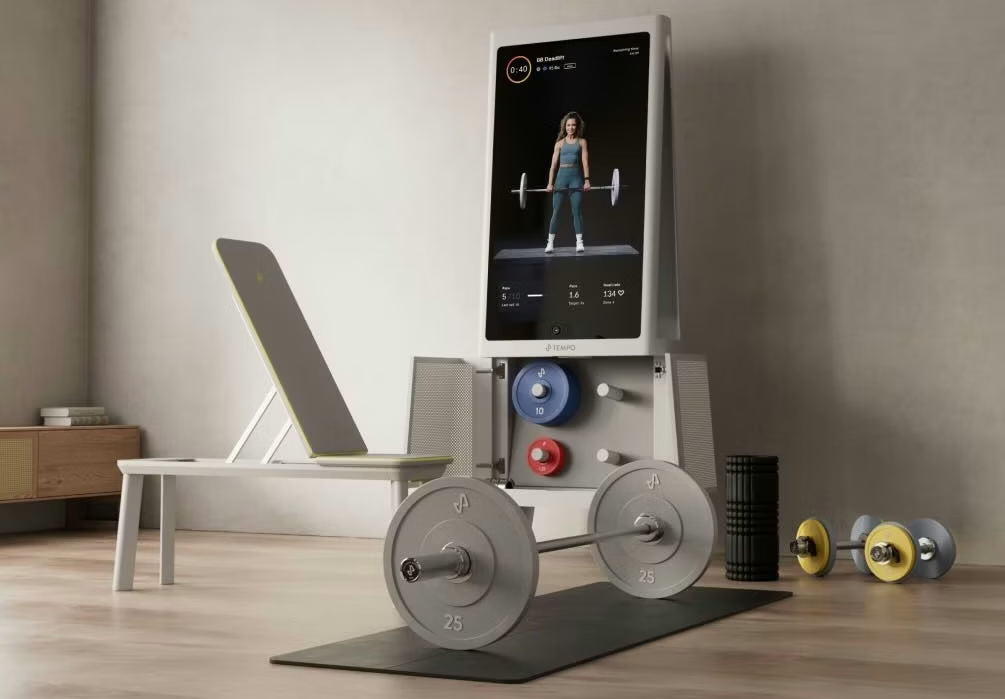
What Is Tempo?
Tempo takes a fundamentally different approach than the other systems on this list: instead of digital motorized resistance, it uses genuine physical weight plates, dumbbells, and a barbell, paired with 3D motion-sensor cameras that track your movement and correct your form in real time. The unit stands roughly six feet tall and stores your weights internally. Current packages (Starter, Plus, Pro) range from approximately $2,246 to $3,596 depending on included equipment.
Tempo vs. Tonal
Where Tonal replaces free weights with digital resistance, Tempo keeps the free weights and adds a coaching layer on top of them. This means Tempo’s “resistance” is limited by how many physical plates you own — the bundled barbell setup tops out around 255 lbs, which exceeds Tonal’s digital ceiling but requires actually loading plates rather than adjusting resistance with a tap. A required $39/month membership unlocks the guided classes and form-feedback features; without it, you’re left with a very expensive weight rack.
Tempo Pros
- Strong, well-reviewed form-correction technology using real-time 3D motion sensing
- Genuinely beginner-friendly guided workout experience
- Uses real physical weights, which some lifters simply prefer to digital resistance
- Lower entry price than Tonal in most package configurations
Tempo Cons
- Not an all-in-one digital resistance system — you’re still loading and unloading actual plates
- Subscription is required to get real value out of the hardware; without it you’re paying premium prices for a basic weight rack
- Large footprint (six feet tall) even though it’s freestanding
- Company has faced public scrutiny over long-term reliability in some independent long-term reviews
Who Should Choose Tempo?
Ideal for someone who values structured coaching and real-time form feedback, doesn’t mind handling physical weights, and wants a more traditional strength-training feel wrapped in smart technology rather than Tonal’s fully digital resistance concept.
4. Echelon Strength+ — Best Budget-Friendly Smart Gym Option
Shop on EchelonFit.com | Shop Echelon Strength on Amazon
What Is Echelon’s Smart Strength Equipment?
Echelon — known for its connected bikes and rowers — also makes two digital strength systems worth knowing apart. The Strength+ (formerly Strength Home) is a freestanding unit that folds into a full-length mirror when not in use, requiring no wall mounting. The separate Strength Pro is a wall-mounted commercial-grade version with higher resistance. Both use dual servo motors delivering digital resistance and feature a 24″ HD touchscreen. The freestanding Strength+ delivers 5–110 lbs of resistance per arm (220 lbs combined) and retails around $3,000; the wall-mounted Strength Pro reaches up to 132 lbs per arm (264 lbs combined).
Echelon vs. Tonal
Echelon’s freestanding Strength+ directly answers Tonal’s biggest drawback — no wall mounting — while landing at a lower price point than Tonal’s $4,295. Multiple lifting modes (Normal, Concentric, Eccentric, Progressive, Isokinetic) roughly match Tonal’s training variety. The tradeoff is the Echelon Premier membership required for the full class library and coaching content, though pricing tiers vary by term length.
Echelon Pros
- Freestanding Strength+ folds flat into a mirror — genuinely useful for small spaces
- Lower upfront cost than Tonal and most other alternatives on this list
- Five distinct resistance modes for exercise variety
- Existing Echelon ecosystem (bikes, rowers) may appeal to current members
Echelon Cons
- Full functionality requires the Premier subscription
- 220 lbs combined resistance on the Strength+ is on the lower end of this comparison group
- The higher-resistance Strength Pro model requires wall mounting, undercutting the portability advantage
- Hardware feel and app polish are generally rated a notch below Tonal and Vitruvian in independent reviews
Who Should Buy Echelon?
Best for people who want a freestanding, mirror-disguised smart strength trainer at a meaningfully lower price than Tonal, and who don’t need to push past 220 lbs of resistance.
5. OxeFit XS1 — Best Premium Tonal Alternative for Full-Body Training
Shop on OxeFit.com | Shop on Amazon

What Is OxeFit?
The OxeFit XS1 is a premium, freestanding platform that goes well beyond strength training alone. Dual servo motors provide up to 250 lbs of resistance from the deck (140 lbs from the weight rack attachment), and the system integrates rowing, kayaking, canoeing, paddleboard, and ski-cross cardio modes alongside digitally controlled Pilates — all through one machine. A built-in force plate tracks balance and weight distribution in real time, flagging asymmetries between your left and right side. Base hardware pricing starts around $3,999 for the tower alone, with fuller accessory packages (Flex, Flow, Peak) pushing total cost toward $5,000–$7,000 depending on configuration. A membership — $44.99–$49.99/month with a 12-month minimum — is required to unlock the full training library.
OxeFit vs. Tonal
OxeFit’s biggest differentiator is scope: where Tonal is purely a strength-training tool, OxeFit combines strength, multiple cardio modalities, and Pilates in a single freestanding unit — genuinely replacing more pieces of equipment than Tonal does. Its 250 lb deck resistance also edges out Tonal’s 200 lb ceiling. The tradeoff is price: once accessories are factored in, OxeFit can cost more than Tonal, not less.
OxeFit Pros
- Broadest range of training modalities of any system on this list (strength, multi-mode cardio, Pilates)
- No wall mounting required
- Force-plate balance tracking is a genuinely unique safety and form feature
- Higher resistance ceiling than Tonal
OxeFit Cons
- Base hardware price is higher than Tonal’s before accessories are even added
- Full accessory packages can exceed $6,000–$7,000
- Larger footprint than most other freestanding alternatives
- Overkill for anyone who only wants basic strength training
Who Should Buy OxeFit?
Target users who want a genuinely premium home gym that replaces multiple pieces of equipment — a squat rack, rowing machine, and Pilates reformer in one — rather than someone simply looking for a cheaper Tonal substitute.
Tonal vs. Alternatives: Which One Is Right for You?
Choose Tonal if you:
- Want the most polished, wall-integrated connected fitness experience available
- Value AI-driven, camera-based form coaching
- Don’t mind a permanent wall installation
- Are comfortable with the ongoing subscription as a fixed cost of ownership
Choose Speediance if you:
- Want a freestanding smart gym at a meaningfully lower entry price
- Like the option to skip the subscription entirely and still get core functionality
- Don’t want to mount anything to a wall
Choose Vitruvian if you:
- Prioritize maximum resistance for serious strength training (440 lbs)
- Want the most portable, storable option on this list
- Prefer not to be locked into a required subscription
Choose Tempo if you:
- Want real-time form coaching built around actual physical weights
- Are a beginner who values structured, camera-guided instruction
- Don’t mind loading and unloading plates rather than using purely digital resistance
Choose Echelon if you:
- Want the lowest-friction, wall-free alternative to Tonal at a lower price point
- Don’t need to exceed roughly 220 lbs of resistance
- Like the idea of equipment that folds away into a mirror
Choose OxeFit if you:
- Want one machine to replace strength equipment, cardio machines, and a Pilates reformer
- Have the budget for a premium, do-it-all system
- Value real-time balance and asymmetry tracking
Disclosure: All product specifications, pricing, and features were verified against manufacturer and retailer sources at the time of writing and are subject to change — always confirm current details on the official product page before buying.
Leave a Reply