- Best Compact Stair Climbers at a Glance
- How We Chose the Best Compact Stair Climbers
- The 7 Best Compact Stair Climbers
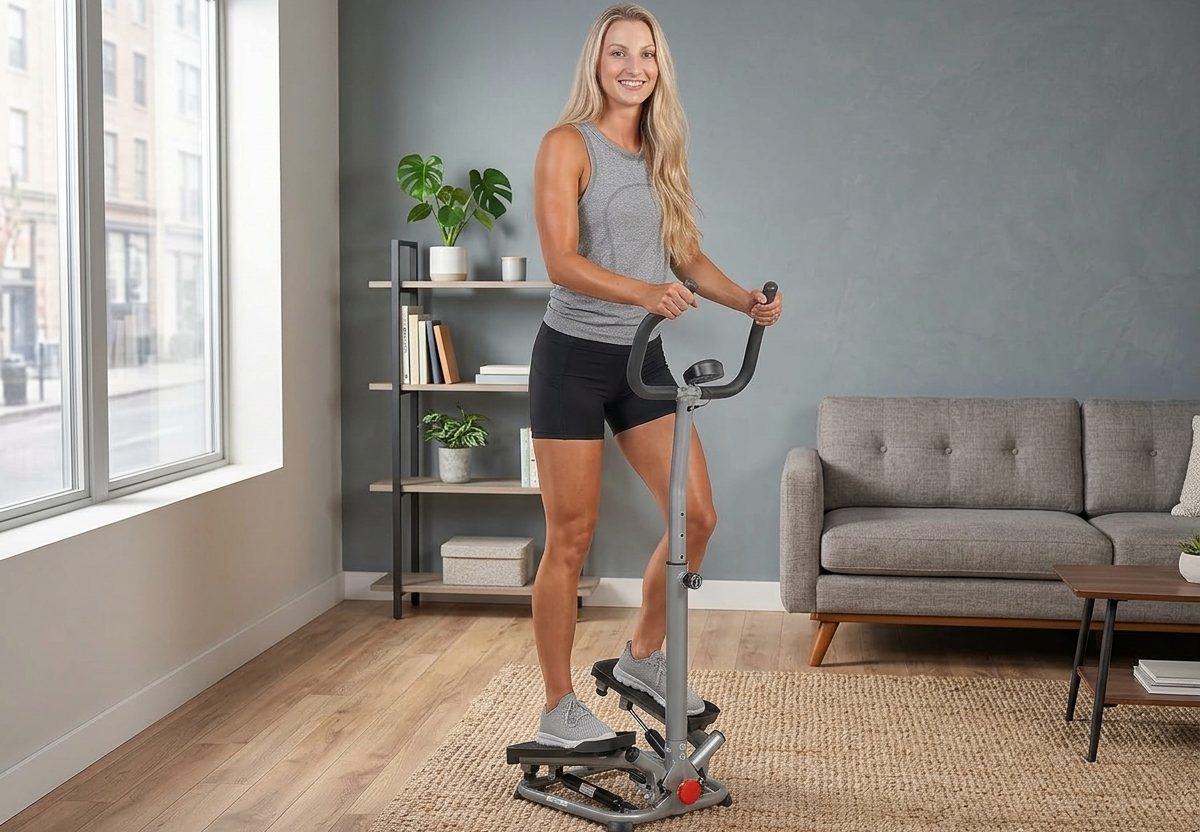
- 1. Sunny Health & Fitness Stair Stepper Machine with Handlebar — Best Overall
- 2. Xiser Commercial Mini Stairmaster — Best for Low Ceilings
- 3. Nordic Lifting Mini Stepper — Best Compact Design
- 4. Sunny Health & Fitness Mini Stepper with Resistance Bands — Best Budget Option
- 5. Xiser Pro Trainer — Best for Serious Workouts
- 6. Sunny Health & Fitness Smart Twist Stair Stepper — Best Smart/Connected Option
- 7. Stamina InStride Pro Electronic Stepper — Best Portable Option
- How Much Ceiling Height Do You Need for a Stair Climber?
- Stair Climber vs. Stepper vs. Stair StepMill
- Compact Stair Climber vs. Treadmill
- How to Choose the Right Compact Stair Climber
- How to Use a Compact Stair Climber for Better Results
- Common Buying Mistakes
- FAQ
- Final Verdict
You don’t need a full-size commercial stairmill to get a genuinely challenging stair-climbing workout. A good compact stair climber delivers the same leg-burning, heart-pounding intensity in a footprint small enough for an apartment corner, a basement with low ceilings, or a bedroom you need to reclaim within minutes of finishing your workout.
Compact stair climbers work especially well for small spaces because most of them (the true “mini stepper” style, specifically) don’t require the tall overhead clearance that a revolving commercial stairmill needs. Your feet move up and down a few inches at a time rather than carrying your whole body up a moving staircase, which is exactly why this category has become a go-to for apartments, basements, and low-ceiling home gyms.
If you’re building out a small-space home gym around a stepper, it pairs naturally with other compact strength equipment. Our guide to the best adjustable dumbbells for small apartments covers the other half of a genuinely space-efficient setup.
Quick summary: The Sunny Health & Fitness Stair Stepper Machine with Handlebar is our best overall pick, the Xiser Commercial Mini Stairmaster is best for low ceilings, the Nordic Lifting Mini Stepper is the smallest footprint, and the Xiser Pro Trainer is our pick for serious, frequent workouts.
Best Compact Stair Climbers at a Glance
| Model | Dimensions | Machine Height | Weight Capacity | Price | Best For |
|---|---|---|---|---|---|
| Sunny Stair Stepper w/ Handlebar | 22.2″L x 15.4″W x 45.7″H | ~46″ | 250 lb | ~$55–110 | Overall best |
| Xiser Commercial Mini Stairmaster | 21″L x 13″W x 14″H | ~14″ | 400 lb | ~$400–850 | Low ceilings |
| Nordic Lifting Mini Stepper | ~1.32 sq ft footprint | ~13″ | 330 lb | ~$50–103 | Smallest footprint |
| Sunny Mini Stepper w/ Bands | ~16.3″L x 12.8″W x 13.6″H | ~14″ | 300 lb | ~$35–90 | Best budget |
| Xiser Pro Trainer | 21″L x 13″W x 14″H | ~14″ | 400 lb | ~$500–900 | Serious workouts |
| Sunny Smart Twist Stepper | Similar to SF-S020027 | ~46″ | 300 lb | ~$70–120 | Smart/connected |
| Stamina InStride Pro | 12″L x 16″W | ~10″ | Not published | ~$60–90 | Most portable |
How We Chose the Best Compact Stair Climbers
We evaluated every model against the same criteria:
Overall footprint: Floor space required for the machine itself, both in use and in storage.
Total user height + machine height + required overhead clearance: This is the real number that matters, not the machine’s height alone. More on this below.
Step range and movement quality: How natural the stepping motion feels, and whether the hydraulics deliver smooth, consistent resistance.
Stability: Whether the base stays planted during a vigorous session, especially without a handlebar to lean on.
Weight capacity: The maximum supported user weight, which varies a lot across this category, from 220 lb on basic mini steppers up to 400 lb on premium models.
Resistance: Whether resistance is adjustable, and how it’s controlled (most compact steppers use sealed hydraulic cylinders rather than magnetic or electronic resistance).
Noise: A real concern for apartments and shared walls; hydraulic systems are generally quieter than mechanical ones.
Portability/storage: Weight, whether it folds, and how easily it tucks into a closet or under furniture.
Display/metrics: Whether the machine tracks steps, time, and calories, and whether it connects to a fitness app.
Durability: Build materials and quality; this is where premium picks like Xiser genuinely separate from budget models.
Price/value: What you’re getting relative to cost, since this category spans from about $35 to $900.
A quick but important point: ceiling clearance matters far more than a spec sheet’s listed “machine height.” A stepper that’s only 14 inches tall can still be the wrong choice for a low-ceiling room if you plan to reach overhead on a handlebar, while a taller-looking machine with no overhead reach requirement might fit just fine. We’ll walk through exactly how to calculate this below.
The 7 Best Compact Stair Climbers
1. Sunny Health & Fitness Stair Stepper Machine with Handlebar — Best Overall

Best for: Most home users who want the reassurance of a handlebar without stepping up to premium pricing.
Pros & cons: The handlebar and stabilizer ring make this noticeably more confidence-inspiring than a handle-free mini stepper, and it’s backed by a well-established brand with 20+ years in home fitness. The 250 lb weight capacity is lower than premium options like Xiser, and it lacks smart connectivity (see our Smart pick below if that matters to you).
Dimensions and clearance requirements: 22.2″L x 15.4″W x 45.7″H assembled; since the handlebar sits at a fixed height rather than requiring overhead reach, most rooms with an 8-foot ceiling accommodate it easily.
Step height/range: Adjustable stepping height that lets you switch between steep climbs (higher resistance) and quick, shallow steps.
Resistance system: Smooth hydraulic cylinders with a twisting, lateral side-to-side step motion that engages the core and outer hips more than a straight up-and-down step.
Stability: A stabilizer ring at the base provides a genuinely solid foundation, addressing the tipping feeling that plagues cheaper mini steppers.
Workout experience: The adjustable handlebar (height-adjustable) gives real balance support, which makes this a good pick for beginners, older adults, or anyone rehabbing an injury, without feeling like a “beginner” machine once you increase resistance.
Noise: Quiet hydraulic operation, apartment-friendly.
Storage: Compact enough to tuck into a corner; not foldable, but the footprint is modest.
Verdict: This is the safest starting point for most buyers, balancing stability, price, and genuine workout intensity.
2. Xiser Commercial Mini Stairmaster — Best for Low Ceilings

Best for: Basements, low-ceiling rooms, or anyone who specifically needs to avoid any overhead reach during a workout.
Overall machine height: Just 14 inches tall, among the lowest-profile steppers on the market.
Maximum user height recommendation: Xiser’s hands-free design is engineered so your torso and head stay essentially stationary while you step, meaning your effective height barely changes during use, a genuine advantage over machines that encourage bouncing or reaching.
Required ceiling clearance: Because there’s no handlebar or console to reach for, required clearance is close to just your standing height plus a small margin, well under any standard ceiling, including many basement ceilings.
Step motion: A precision hydraulic system engineered by a professor of biomechanics for correct hip and knee alignment; the pedals are spaced about 2.5 inches apart, which takes brief getting used to but delivers a genuinely different training stimulus than wider-set steppers.
Stability: Aircraft-grade aluminum alloy construction rated for 400 lb, exceptionally sturdy given its 14–15 lb weight.
Pros & cons: Made in the USA with a real track record (some owners report units still running strong after two decades), and it folds to just 4 inches thick for storage. The price is a real jump from basic mini steppers, and the hands-free design without any handlebar takes some balance adjustment for first-time users.
3. Nordic Lifting Mini Stepper — Best Compact Design

Best for: Apartments and very small rooms where every square foot of floor space counts.
Pros & cons: Genuinely tiny and light, with a 330 lb weight capacity that’s generous for its size and price. Some users report it can feel a bit less stable during aggressive, fast-paced sessions than heavier or handlebar-equipped options, and there have been some noise complaints at higher resistance.
Smallest footprint: At roughly 1.32 square feet of floor space, this is among the smallest verified footprints in this category.
Portability: Just 15.2 lbs, light enough to lift with one hand and relocate around your home in seconds.
Storage: Small enough to slide into a closet shelf or under a bed with room to spare.
Workout capabilities: Comes with three sets of resistance bands (20″, 28″, and 39″ with D-ring handles) so you can add upper-body work between stepping intervals, plus an LCD monitor tracking time, steps, and calories.
4. Sunny Health & Fitness Mini Stepper with Resistance Bands — Best Budget Option

Best for: Beginners on a tight budget who want to try stair-stepping cardio before investing more.
Price: Frequently found between $35 and $60 on sale, making it one of the least expensive genuinely functional steppers available.
Build quality: A heavy-duty steel frame with non-slip pedals and a stabilizing base ring, solid construction for the price point.
Resistance: Smooth, quiet hydraulic cylinders.
Maximum user weight: 300 lb, a strong capacity given the low price.
Features: Removable resistance bands for upper-body work, an LCD monitor, and optional free Bluetooth connectivity to the SunnyFit app for guided workouts.
Pros & cons: The value here is hard to beat, genuinely functional cardio equipment for less than the cost of a few gym class-drop-ins. As with most budget mini steppers, there’s no handlebar, so balance relies entirely on your own core stability, which may not suit true beginners or anyone with balance concerns.
5. Xiser Pro Trainer — Best for Serious Workouts

Best for: Experienced users, trainers, or anyone planning frequent, high-intensity sessions who wants equipment that won’t wear out.
Step range: The same biomechanically engineered hydraulic stepping motion as the Xiser Commercial, tuned for sustained, demanding use.
Resistance: Adjustable hydraulic resistance that lets you move fluidly between steady cardio and explosive, high-intensity intervals.
Durability: Built specifically for heavier or more frequent use than the standard Commercial model, aircraft-grade cast aluminum construction designed to hold up under repeated hard efforts, used by trainers, teams, and gyms.
Workout intensity: Genuinely supports serious high-intensity interval training (HIIT) and sprint-style stepping, not just steady-state cardio.
Stability under heavy use: This is the Pro Trainer’s whole reason for existing over the standard Commercial model, reinforced components built to withstand years of hard, frequent training rather than occasional home use.
Pros & cons: If you’re training multiple times a week at real intensity, this is built to take it in a way budget mini steppers simply aren’t. It’s a genuine investment, priced well above the rest of this list, and the hands-free, no-handlebar design still requires good balance and core control.
6. Sunny Health & Fitness Smart Twist Stair Stepper — Best Smart/Connected Option

Best for: Tech-focused users who want guided workouts and progress tracking without paying a subscription fee.
Pros & cons: The free app (no subscription fee) is a genuine value-add over competitors that charge monthly for similar content. It shares the same core hardware and 250-300 lb capacity range as Sunny’s non-smart steppers, so the appeal here is entirely about the connected features, not a fundamentally different machine underneath.
Display: An LCD monitor tracking time, calories, steps per minute, and total count, paired with Bluetooth connectivity for a fuller picture of your workout.
Workout tracking: Connects to the free SunnyFit app, which logs your sessions automatically rather than requiring manual entry.
App connectivity: The SunnyFit app unlocks over 1,000 trainer-led workout videos and more than 10,000 virtual scenic routes, letting you “walk” or “climb” through filmed locations while you step.
Training programs: Structured programs within the app help guide interval pacing and progression rather than leaving you to freestyle every session.
Metrics: All the standard stepper metrics, plus the ability to review workout history over time inside the app rather than losing your data when you step off.
7. Stamina InStride Pro Electronic Stepper — Best Portable Option

Best for: Users who need to store or move their equipment regularly, including anyone splitting time between a home office and a living space.
Pros & cons: The genuinely small footprint and light weight make this one of the easiest steppers to actually relocate around a home (or take on a trip), and Stamina has decades of history in this exact product category. Reviewers note the electronic monitor is fairly basic, and like most true mini steppers, there’s no handlebar for balance support.
Weight: Just 20 lbs, genuinely easy to lift and carry one-handed.
Carrying/storage: A compact 12″ x 16″ footprint that Stamina specifically markets around taking the stepper “anywhere,” from a home office to a hotel room.
Setup: No assembly required out of the box; just place it on a flat surface and step on.
Performance: Two hydraulic cylinders provide smooth, consistent resistance through the full range of motion, effective for calves, thighs, glutes, and core.
How Much Ceiling Height Do You Need for a Stair Climber?
This is genuinely the most important question to answer before buying, and it’s more nuanced than just checking a machine’s listed height.
Why the machine’s listed height isn’t enough: A spec sheet might list “machine height: 14 inches,” but that only tells you how tall the equipment is when you’re not standing on it. What actually matters is how much vertical space you, the user, occupy while using it, which depends on your height, whether you reach overhead, and how energetically you move.
Calculating your required clearance: For a true mini stepper (feet-only movement, no overhead reach), your effective height barely changes during use, since you’re essentially marching in place rather than climbing a rising staircase. A reasonable formula is:
Required clearance = Your standing height + 10–14 inches of margin (for a natural stepping motion, minor upward bounce, and a comfortable buffer)
If you’ll be using a handlebar model and occasionally reaching overhead to stretch or adjust your grip, add your overhead reach instead, which for most adults is roughly 1.3 times standing height.
Example calculations:
| Height | Mini Stepper (no overhead reach) | With Occasional Overhead Reach |
|---|---|---|
| 5’4″ (64″) | ~74–78″ clearance | ~85–89″ clearance |
| 5’8″ (68″) | ~78–82″ clearance | ~89–93″ clearance |
| 6’0″ (72″) | ~82–86″ clearance | ~94–98″ clearance |
| 6’4″ (76″) | ~86–90″ clearance | ~99–103″ clearance |
A standard 8-foot ceiling is 96 inches. As the table shows, nearly anyone can use a true mini stepper (Xiser, Nordic Lifting, Sunny mini steppers, Stamina InStride) comfortably in a standard room or even a 7-foot basement ceiling (84 inches), since these machines don’t require overhead reach. Taller users specifically planning to stretch overhead on a handlebar model should double-check their room’s actual clearance against the higher figure.
Why stair climbers can be problematic in basements: The issue usually isn’t the mini stepper itself, it’s ductwork, support beams, light fixtures, or sloped ceilings that reduce your actual usable clearance below the room’s stated ceiling height. Always measure your specific workout spot, not just the room’s tallest point.
Will it fit my ceiling? Quick reference:
- 7-foot ceiling (84″): Fine for true mini steppers up to about 6’2″ without overhead reach.
- 7.5-foot ceiling (90″): Fine for true mini steppers at any adult height; handlebar models fine up to about 5’8″ with occasional overhead reach.
- 8-foot ceiling (96″): Fine for true mini steppers at any height; handlebar models fine up to about 6’0″ with overhead reach.
- 9-foot+ ceiling: No meaningful restrictions for any compact stepper on this list.
Before you buy: Physically stand in your intended workout spot, raise your arms as high as you comfortably would during a workout, and see how much clearance remains. This five-second test is more reliable than any formula.
Stair Climber vs. Stepper vs. Stair StepMill
The terminology in this category gets genuinely confusing, so here’s a plain breakdown:
Compact stair climber / mini stepper: Two pedals connected to hydraulic cylinders that resist as you press down alternately. This describes most products in this guide (Sunny, Xiser, Nordic Lifting, Stamina). Requires minimal ceiling clearance.
Stair stepper: Often used interchangeably with “mini stepper,” though sometimes refers to slightly larger models with a handlebar and stabilizer base, like our overall pick.
Vertical climber: A taller machine (like a MaxiClimber) with overhead handles you pull down while stepping, simulating a ladder-climbing motion. This genuinely does require significant overhead clearance since your arms fully extend upward, often 8+ feet.
Commercial StepMill: A true revolving staircase (like a StairMaster gym machine) with moving steps that continuously rotate beneath you. These are large, heavy, expensive, and require serious ceiling clearance and floor space, well outside the “compact” category this guide covers.
Which provides the closest experience to climbing real stairs? A commercial StepMill, by a wide margin, since it replicates an actual moving staircase. Among compact options, handlebar-equipped mini steppers with a taller step range feel closest.
Which requires the least ceiling height? True mini steppers without overhead handles (Xiser, Nordic Lifting, Stamina, and similar), since your body doesn’t meaningfully rise during use.
Which burns the most energy per minute? Generally the StepMill, since it demands the most complete range of motion and largest muscle recruitment; among compact options, higher-resistance sessions on any mini stepper can still reach a genuinely vigorous intensity when performed with proper effort.
Compact Stair Climber vs. Treadmill
| Compact Stair Climber | Treadmill | |
|---|---|---|
| Footprint | Small (1–3 sq ft typical) | Large (15+ sq ft typical) |
| Ceiling clearance | Minimal for mini steppers | Standard room height |
| Cardio intensity | High per minute at real effort | High, especially at speed/incline |
| Joint impact | Low-impact, no ground strike | Higher-impact, especially running |
| Storage | Easy, often under a bed or in a closet | Requires dedicated floor space, even folded |
| Noise | Generally quiet (hydraulic) | Motor and belt noise, more noticeable |
| Muscle groups | Glutes, quads, hamstrings, calves, core | Primarily legs, some core |
| Workout variety | More limited | Wide range of paces, inclines, programs |
| Cost | $35–900 | $300–3,000+ |
When a compact stair climber makes more sense than a treadmill: If floor space or budget is your main constraint, if you want a lower-impact option than running, or if you specifically want to target glutes and lower-body strength more than a flat treadmill walk provides. A treadmill remains the better choice if you want to actually run, need a wider range of workout intensities and durations, or prefer walking-based cardio for longer sessions.
How to Choose the Right Compact Stair Climber
Choose based on:
- Ceiling height: Use the clearance formula above; this should be your first filter, not your last consideration.
- User height: Taller users planning overhead reach need more room; shorter users have more flexibility across the whole category.
- Available floor space: Even the smallest steppers need a few square feet of clear, flat floor.
- Desired workout intensity: Casual users can go with any budget mini stepper; frequent or high-intensity trainers should look at Xiser’s Commercial or Pro Trainer tiers.
- Weight capacity: Match the machine’s rated capacity to your body weight with real margin, not right at the limit.
- Noise tolerance: All the models here use quiet hydraulics, but base stability (a stabilizer ring or wider footprint) reduces incidental floor noise too.
- Storage requirements: If you need to fully put the machine away between uses, prioritize the lightest, smallest options (Nordic Lifting, Stamina InStride Pro).
- Budget: This category spans roughly $35 to $900; decide what tier of durability and features you actually need before shopping.
- Smart features: If app-guided workouts and progress tracking matter to you, prioritize models with Bluetooth connectivity.
5 questions to answer before buying:
- What’s my actual, measured ceiling clearance at my workout spot?
- Do I want or need a handlebar for balance and stability?
- How many times per week will I realistically use this?
- Do I need it to store away completely, or can it live in a corner?
- Is a connected app and workout tracking important to me, or just a distraction?
How to Use a Compact Stair Climber for Better Results
Beginner 10-minute workout: 2 minutes easy pace to warm up, then 6 minutes at a moderate, sustainable pace, finishing with 2 minutes easy to cool down.
20-minute fat-loss/cardio workout: 3 minutes warm-up, then alternate 2 minutes moderate pace with 1 minute higher intensity for 6 rounds (18 minutes), finishing with a brief cool-down.
30-minute interval workout: 5 minutes warm-up, then 8 rounds of 1 minute high intensity followed by 1.5 minutes recovery pace (20 minutes), finishing with 5 minutes cool-down.
How to increase resistance: Most compact steppers adjust resistance either through a dial (hydraulic cylinders) or, on handlebar models, by adjusting the step height range; increase gradually rather than jumping straight to maximum resistance.
How to progress without simply exercising longer: Increase resistance, shorten your rest intervals, add resistance bands for upper-body work between stepping sets, or increase your stepping cadence (steps per minute) rather than just adding minutes to every session.
Proper posture and hand placement: Keep your torso upright rather than leaning heavily on a handlebar (if present), engage your core, and avoid locking your knees at the top of each step. On handle-free models, keep a slight bend in your knees throughout for balance.
Common form mistakes: Bouncing excessively (wastes energy and can strain joints), leaning too far forward, only using the front half of the pedal, and holding your breath during harder intervals.
Common Buying Mistakes
- Checking only machine dimensions. As covered above, machine height alone doesn’t tell you whether it’ll actually fit your space; factor in your own height and range of motion.
- Forgetting ceiling clearance. This is the single most common regret buyers report, always measure your actual workout spot first.
- Choosing a machine with insufficient step height. A stepper with a very shallow step range may feel too easy once you’re past the beginner stage.
- Ignoring user weight capacity. Buying right at your body weight’s limit strains the machine and shortens its lifespan; leave real margin.
- Buying solely based on price. The cheapest options can still be genuinely useful for light use, but don’t expect Xiser-level durability from a $40 mini stepper.
- Assuming a “mini stepper” replicates a full stair climber. The muscle engagement is similar, but the range of motion and intensity ceiling are both lower than a true revolving StepMill.
- Ignoring noise and floor vibration. Even quiet hydraulic steppers can transmit some vibration through the floor; a mat underneath helps in apartments.
- Not measuring storage space. If the machine needs to disappear between workouts, confirm it actually fits your intended storage spot (closet shelf, under a bed) before buying.
FAQ
What is the best compact stair climber? For most home users, the Sunny Health & Fitness Stair Stepper Machine with Handlebar offers the best balance of stability, price, and workout intensity.
What stair climber is best for a low ceiling? The Xiser Commercial Mini Stairmaster, at just 14 inches tall with a hands-free design that keeps your torso stationary, requires the least overhead clearance of any model in this guide.
How much ceiling height do you need for a stair climber? For a true mini stepper without overhead reach, your standing height plus about 10 to 14 inches of margin is generally sufficient, well under a standard 8-foot ceiling for nearly any adult height.
Can I use a stair climber in a basement? Yes, in most cases, as long as you measure your actual clearance at the workout spot (accounting for ductwork, beams, or sloped ceilings) and stick to a true mini stepper rather than a vertical climber if your ceiling is under 7.5 feet.
Are compact stair climbers effective? Yes. Research on stair-climbing exercise has found meaningful cardiovascular fitness improvements, including a documented 17% increase in VO2max after eight weeks of short, consistent stair-climbing sessions in previously sedentary participants.[1] More recent research has confirmed similar cardiorespiratory benefits from brief, vigorous stair-climbing intervals.[2]
Is a mini stepper the same as a stair climber? Largely yes, the terms are often used interchangeably for this category, though “stair climber” can sometimes refer to taller vertical climbers or commercial StepMills, which are meaningfully different machines with different space requirements.
Are stair climbers good for weight loss? They can be a genuinely effective part of a calorie-deficit routine, since stair climbing demands significant energy per minute compared to many other cardio machines.[3] Weight loss ultimately depends on total training volume, consistency, and diet, not any single piece of equipment.
How much space does a stair climber need? Most compact steppers in this guide need only 1 to 3 square feet of floor space, dramatically less than a treadmill or elliptical.
Is a stair climber better than a treadmill? Neither is universally better; stair climbers offer a smaller footprint, lower impact, and more targeted lower-body engagement, while treadmills offer more workout variety and the option to actually run.
Final Verdict
The Sunny Health & Fitness Stair Stepper Machine with Handlebar is our best overall pick, striking the right balance of stability, price, and genuine workout intensity for most home users.
- Low ceilings: Xiser Commercial Mini Stairmaster, for its minimal 14-inch profile and hands-free design.
- Smallest footprint: Nordic Lifting Mini Stepper, at roughly 1.32 square feet.
- Budget: Sunny Health & Fitness Mini Stepper with Resistance Bands, frequently available under $60.
- Serious workouts: Xiser Pro Trainer, built for frequent, high-intensity use.
- Smart features: Sunny Health & Fitness Smart Twist Stair Stepper, with free app-guided workouts.
- Portability: Stamina InStride Pro Electronic Stepper, at just 20 lbs with a genuinely tiny footprint.
Whichever model you choose, the single most important step before buying is measuring your ceiling and accounting for your full standing height, not just glancing at a spec sheet. Get that right, and any of these seven machines can deliver a genuinely effective, space-efficient cardio workout.
References
[^1]: Boreham CA, Wallace WF, Nevill A. “Training effects of short bouts of stair climbing on cardiorespiratory fitness, blood lipids, and homocysteine in sedentary young women.” Preventive Medicine. 2005. Found a 17.1% increase in VO2max after short bouts of stair climbing over the training period. View on PubMed
[^2]: “Effect of brief intense stair climbing on cardiorespiratory fitness and metabolic risk factors in inactive young men with obesity: A randomized controlled trial.” Nutrition, Metabolism and Cardiovascular Diseases. 2025. Found significant VO2peak improvements from brief, vigorous stair-climbing intervals over 4 weeks. Read the study
[^3]: Prieto-González P, Yagin FH. “Energy expenditure, oxygen consumption, and heart rate while exercising on seven different indoor cardio machines at maximum and self-selected submaximal intensity.” Frontiers in Sports and Active Living. 2024. Read the study on PMC
This article is for general informational and educational purposes only and is not intended as medical or professional fitness advice. Talk with a doctor before starting a new exercise program, especially if you have an existing joint condition, heart condition, balance issue, or other health concern. Always confirm your actual ceiling clearance at your intended workout location before purchasing any stair climber or stepper, and stop use immediately if you experience dizziness, joint pain, or loss of balance. Product names, prices, dimensions, and specifications mentioned in this article are accurate as of the time of writing but may change; always verify current pricing and specs directly with the manufacturer or retailer before purchasing.
Leave a Reply