- The Real Problem: Why Quad Soreness Is Stubborn
- Step 1: Understand What Each Tool Actually Does
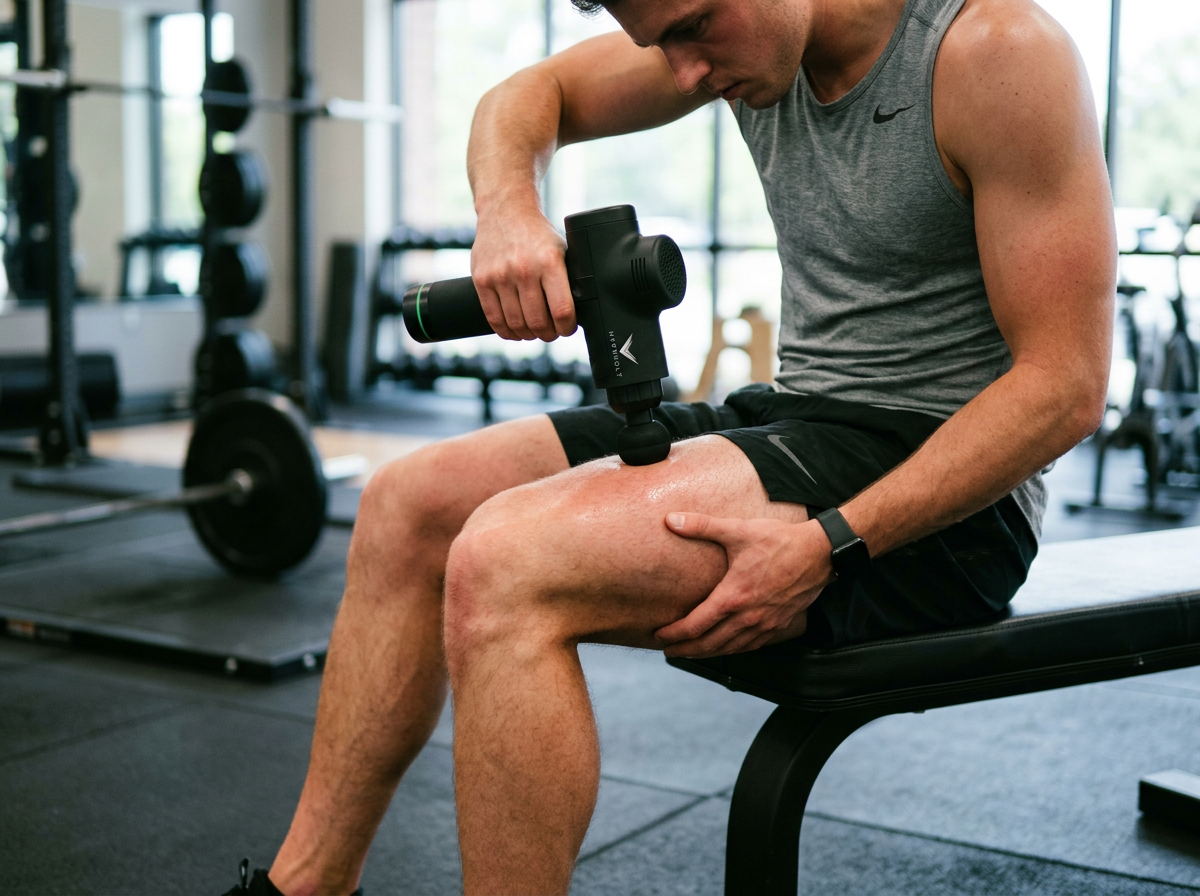
- Step 2: How to Use a Massage Gun on Sore Quads (Without Making It Worse)
- Step 3: How to Foam Roll Sore Quads the Right Way
- Step 4: Avoid These Common Mistakes on Both Tools
- Step 5: The Verdict — Massage Gun or Foam Roller for Sore Quads?
- The Best Tool Is the One You'll Actually Use
Your quads are screaming after leg day. Maybe it was squats, lunges, or a long run — whatever the cause, that deep, achy soreness in your thighs is hard to ignore. You’ve got two tools sitting in the corner: a massage gun and a foam roller. Which one do you grab?
This is one of the most common questions in recovery circles, and the answer isn’t as simple as “one is better.” Both tools work — but they work differently, and knowing when to use each one can mean the difference between bouncing back fast and limping through your next workout.
This post breaks down the science, the technique, and the verdict, so you can make the right call for your quads every time.
The Real Problem: Why Quad Soreness Is Stubborn
The quadriceps are the largest muscle group in the legs — four muscles running from your hip to your knee. After hard training, microscopic tears in those muscle fibers trigger inflammation and delayed onset muscle soreness (DOMS), typically peaking 24 to 48 hours post-workout.1
Because the quads are so dense and large, they hold tension deep beneath the surface — which is exactly why surface-level stretching often doesn’t cut it. You need mechanical pressure to break up adhesions, stimulate blood flow, and signal the nervous system to release that tension.
That’s where percussion therapy (massage guns) and myofascial release (foam rollers) come in. They’re both doing versions of the same job, but with different mechanisms and results.
Step 1: Understand What Each Tool Actually Does
Before you pick up either tool, know what you’re working with.
Percussion Therapy (Massage Gun):
- Delivers rapid, targeted pulses — typically 1,200 to 3,200 percussions per minute — deep into muscle tissue
- Stimulates blood flow, reduces muscle stiffness, and overrides pain signals through the nervous system
- Works on a specific area at a time
- Best for pinpointing tight knots or dense muscle bellies
Myofascial Release (Foam Roller):
- Uses sustained, broad pressure to stretch and release the fascia (the connective tissue surrounding your muscles)
- Works over a larger surface area at once
- Improves tissue mobility and flexibility over time
- Best for overall quad coverage and IT band tension
Research shows that both tools can meaningfully reduce DOMS and improve range of motion post-exercise, though the mechanisms differ. 2 Think of a massage gun as a scalpel and a foam roller as a rolling pin — both shape dough, but one gives you far more precision.
Step 2: How to Use a Massage Gun on Sore Quads (Without Making It Worse)
A massage gun is powerful, and used incorrectly it can bruise tissue or aggravate inflammation. Follow this protocol:
What you’ll need: A mid-range percussion massager with adjustable speeds and interchangeable heads. The Theragun Prime is a reliable choice that balances power and control without being overkill for home use.
How to do it:
- Start on the lowest speed setting. Your quads are already inflamed — high intensity on sore tissue can increase irritation in the first 24 hours.
- Use the large ball attachment. This spreads the percussion across more surface area, which is ideal for broad muscles like the quads.
- Move slowly along the muscle belly. Glide the gun from just above the knee to the mid-thigh, then mid-thigh to the hip. Spend about 10–15 seconds per zone.
- Avoid bony landmarks entirely. Do not run the gun over your kneecap, your hip bone, or anywhere you feel bone beneath the skin. Percussion on bone is painful and does nothing useful.
- Limit each session to 2 minutes per quad. More is not better. You want to stimulate — not beat up — sore tissue.
Signs you’re doing it right: The area feels warmer and slightly looser after. A mild, pleasant soreness during use is normal.
Signs to stop: Sharp pain, skin bruising within minutes, or increased pain after the session.
Step 3: How to Foam Roll Sore Quads the Right Way
Foam rolling is lower intensity than a massage gun, making it easier to use in the 24–48 hour window when soreness is at its peak. It’s also harder to mess up — but people still do.
What you’ll need: A high-density foam roller with enough firmness to actually do the work. The TriggerPoint GRID Foam Roller has a multi-density surface that gets into the tissue without being unbearably aggressive.
How to do it:
- Get into a forearm plank position with the roller placed just above your knees. Your core should be engaged, not collapsed.
- Slowly roll toward your hip, then back. The full stroke should take about 3–4 seconds in each direction — do not rush.
- When you hit a tender spot, pause. Hold pressure on that spot for 20–30 seconds and breathe slowly. This sustained pressure is what causes the fascia to release.
- Rotate your leg slightly inward and outward to catch the inner and outer quad separately. The vastus medialis (inner) and the area near the IT band (outer) are commonly neglected.
- Avoid rolling directly over the knee joint. Start two inches above the kneecap and stop there.
Spend 60–90 seconds per leg per session. You can foam roll more frequently than you’d use a massage gun — once in the morning and once at night works well during heavy soreness.
Step 4: Avoid These Common Mistakes on Both Tools
Whether you’re using percussion or pressure, these errors will slow your recovery:
- Rolling or percussing directly on the IT band. The IT band is a tendon, not a muscle — it can’t actually release. Working the TFL (the muscle at your hip) and the vastus lateralis nearby is far more effective.
- Going too hard, too soon. Sore quads in the first 24 hours still have active inflammation. Aggressive pressure can worsen it. Start gentle.
- Skipping the warmup. Neither tool is a substitute for warming up. Use them after light movement, not instead of it.
- Holding your breath. Tension in your breath creates tension in your muscles. Slow, deliberate exhales during foam rolling especially help the tissue release.
- Using a cheap, soft foam roller. A roller that compresses completely under your bodyweight isn’t doing anything. Density matters.
Step 5: The Verdict — Massage Gun or Foam Roller for Sore Quads?
Here’s the clear breakdown:
Choose a massage gun when:
- You have a specific, localized knot or tight spot in the quad
- You need fast relief and have limited time (2–3 minutes per leg)
- You’re post-workout by more than 48 hours and inflammation has subsided
- You want to warm up a specific area before training
Choose a foam roller when:
- Your soreness is broad and general across the whole thigh
- You’re in the 24–48 hour DOMS window (peak soreness)
- You want to improve overall tissue mobility and flexibility
- You’re on a budget — rollers are significantly cheaper and still highly effective
Use both when:
- Recovery is a high priority and you have the time
- You foam roll first to warm and loosen the tissue, then use the massage gun to target specific spots
For most people dealing with sore quads after training, the foam roller wins for that initial 48-hour window. Once soreness fades to stiffness, the massage gun takes over.
A well-reviewed option that handles both needs is the Hypervolt 2 Pro by Hyperice — quiet, adjustable, and effective enough to cover the whole lower body without fatigue. 3
The Best Tool Is the One You’ll Actually Use
Both tools work. The difference is timing, technique, and specificity. Foam rollers give you broad myofascial coverage and are gentler during acute soreness. Massage guns give you targeted, fast relief once your muscles are ready for deeper input.
The worst thing you can do is nothing. Sitting with quad soreness and hoping it passes means slower recovery, tighter tissue, and a harder workout next time. Pick up whichever tool you have, use it correctly, and give your legs what they need.
Still dealing with persistent thigh soreness that won’t budge? You might need a more complete approach. Check out our full guide on how to relieve sore muscles in thighs for a deeper look at hydration, sleep, nutrition, and stretching strategies that work alongside your recovery tools.
This content is for informational and educational purposes only. It is not intended to diagnose, treat, cure, or heal any medical condition or injury. Always consult a licensed healthcare professional, physical therapist, or physician before beginning any new recovery protocol — especially if you are experiencing pain beyond typical muscle soreness, have a pre-existing condition, or have recently sustained an injury.
References:
- Cheung, K., Hume, P., & Maxwell, L. (2003). Delayed onset muscle soreness: Treatment strategies and performance factors. Sports Medicine, 33(2), 145–164. https://doi.org/10.2165/00007256-200333020-00005 ↩︎
- Pearcey, G. E. P., et al. (2015). Foam rolling for delayed-onset muscle soreness and recovery of dynamic performance measures. Journal of Athletic Training, 50(1), 5–13. https://doi.org/10.4085/1062-6050-50.1.01 ↩︎
- Konrad, A., et al. (2020). The acute effects of a percussive massage treatment with a massage gun compared to a conventional massage on the muscles of the upper leg. Journal of Sports Science & Medicine, 19(4), 690–694. https://www.ncbi.nlm.nih.gov/pmc/articles/PMC7675623/ ↩︎
Leave a Reply