
- What Do We Mean by "Bad Knees"?
- Can Exercise Really Help Sore Knees?
- First, a Few Safety Rules
- How Much Pain Is Okay?
- How to Use This Plan
- What You Need
- The 7 Exercises
- Where to Go for More Walking and Balance Ideas
- Moves to Go Easy On
- Your 4-Week Starter Schedule
- On Sore-Knee Days
- Other Things That Can Help
- Common Mistakes to Avoid
- Frequently Asked Questions
- The Bottom Line
Sore, stiff knees can make everyday life feel harder. Stairs, long walks, and getting out of a chair all start to feel like a big effort. It is tempting to rest and avoid movement, but gentle exercise is often part of the answer.
This guide shares 7 low-impact exercises that are kind to sore knees, along with an honest look at what the research really shows. For a wider plan that covers walking, balance, and strength, see our free exercise and fitness guide for seniors over 60.
Please check with your doctor first, especially if your knees are swollen, if you have had a knee injury or replacement, or if you are not sure what is causing your pain. This guide is general information, not a diagnosis.

What Do We Mean by “Bad Knees”?
Knee pain in older adults has many causes. A common one is osteoarthritis, a condition where the cartilage in the joint thins over time and the joint becomes stiff and sore. Other causes include old injuries and tendon problems.
That is why a doctor’s check matters. The exercises here are general and gentle, but the right plan for you depends on what is going on inside your knee.
Can Exercise Really Help Sore Knees?
Exercise is one of the first things doctors recommend for knee arthritis. The American College of Rheumatology and the Arthritis Foundation strongly recommend exercise for knee osteoarthritis, along with tai chi.
A large 2024 review of 139 trials found that exercise probably improves pain, physical function, and quality of life in the short term. But the authors had only low to moderate confidence in the results. They also said the benefits were of uncertain clinical importance, meaning some people may not notice a big change.
Here is the most important part for this post. The review found no clear difference between types of exercise, and the guideline says no single exercise is proven best. So the 7 moves below are gentle, commonly used choices, not a proven “best.”
Think of exercise as a helpful tool, not a cure. The same review found that exercise may increase side effects in some comparisons, so it pays to start gently.
First, a Few Safety Rules
Talk to your doctor or a physical therapist before you start if any of these apply to you:
- Your knee is swollen, red, or warm
- You have had a recent injury, fall, or knee surgery
- Your knee locks, catches, or gives way
- You have heart, balance, or bone problems
- You are not sure what is causing your knee pain
Stop and get medical help for sudden severe pain, fever, or pain in your calf with swelling or warmth. Do not push through those signs.
How Much Pain Is Okay?
Many people worry that any pain during exercise means harm. The research is more relaxed than that. A review of trials in chronic muscle and joint pain found that pain during exercise “need not be a barrier” to good results.
That review covered chronic pain in general, not just knees. A common rule of thumb among physical therapists is to stay at mild discomfort, about 3 or 4 out of 10 at most. Your knee should feel settled again within a day.
If your pain is sharp, grows during the move, or is worse the next day, ease back. Use a smaller range, fewer reps, or skip that move for now.
How to Use This Plan
Do the strength moves, numbers 1 through 5, on two or three non-consecutive days a week. Start with 1 set of 8 reps each, and build to 2 sets of 10 over about four weeks. Rest a minute between sets.
The World Health Organization advises older adults to do balance and strength training at moderate or greater intensity on 3 or more days a week. Moves 6 and 7 can fill your other days.
Warm up first with 3 to 5 minutes of marching in place or an easy walk. Move slowly, and breathe out as you push or lift.
What You Need
You do not need a gym. A sturdy chair, a kitchen counter, and a firm bed or mat are enough for moves 1 through 5. Add supportive shoes, and a bike or pool if you have access to one.
The 7 Exercises
1. Sit-to-Stand
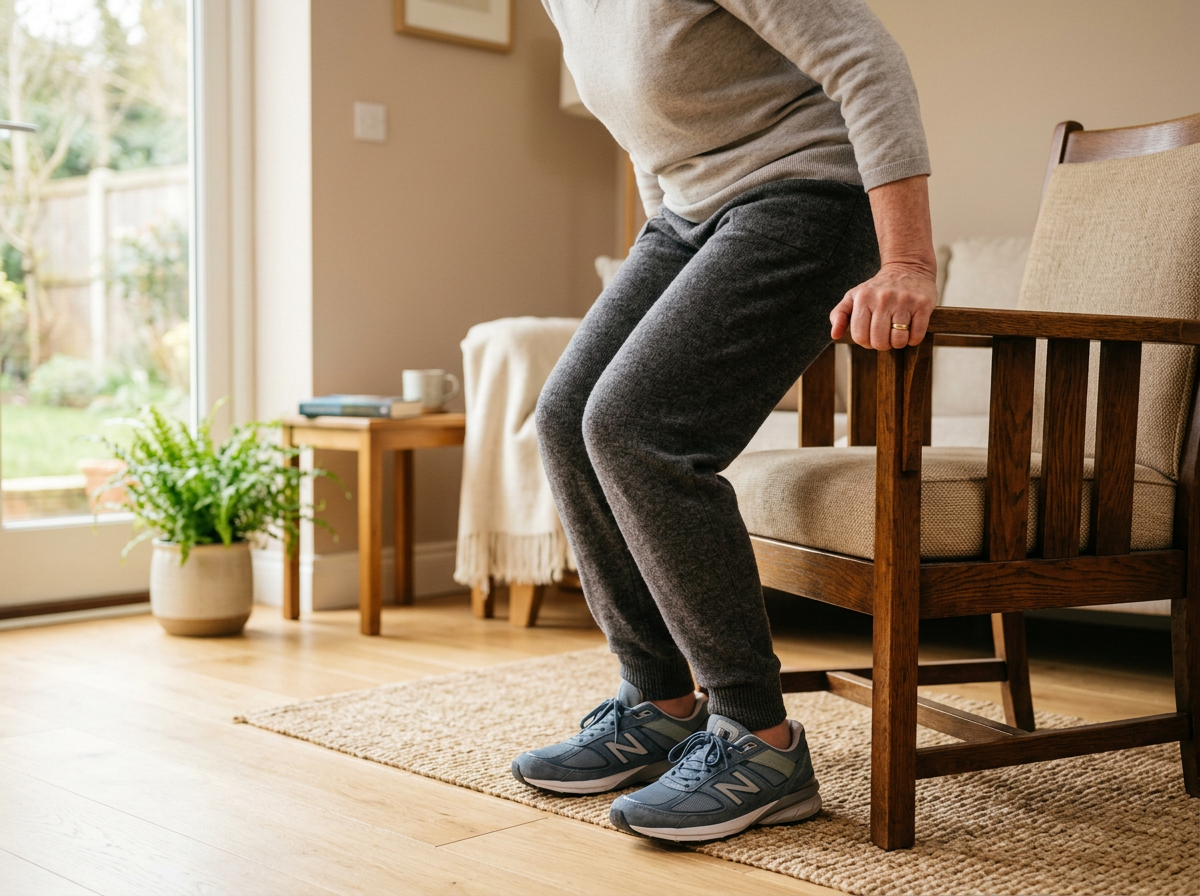
Sit near the front of a sturdy chair with your feet flat. Lean forward a little, stand all the way up, then sit back down slowly. This builds the thigh and hip muscles that help carry your body weight.
Easier: Use a higher seat or a firm cushion, and push lightly with your hands. Watch for: Keep your knees pointing the same way as your toes.
2. Straight-Leg Raise
Lie on your back, or sit with your back well supported. Bend one knee with that foot flat, and keep the other leg straight. Tighten the thigh of the straight leg, lift it to the height of the bent knee, and lower it slowly.
Easier: Lift only a few inches. Watch for: Keep your lower back flat, and do not hold your breath.
3. Glute Bridge
Lie on your back with your knees bent and your feet flat. Squeeze your buttocks and lift your hips until your body makes a straight line from shoulders to knees. Lower slowly.
Easier: Lift just a little, or do this on a firm bed. Watch for: Keep your feet and knees about hip-width apart.
4. Standing Hamstring Curl
Stand tall and hold a counter for balance. Bend one knee and bring your heel toward your buttock. Lower your foot slowly.
Easier: Bend only part of the way. Watch for: Keep your thighs side by side, and do not swing your leg.
Where to Go for More Walking and Balance Ideas
Strength is only one part of keeping your knees happy. Walking, balance practice, and everyday movement matter too. Our seniors fitness guide has easy ideas you can mix in on your non-strength days.
5. Side Leg Raise
Stand tall and hold a counter. Lift one leg out to the side a few inches, with your toes pointing forward, then lower it slowly. This works the hip muscles that help keep your knee steady.
Easier: Lift a smaller amount. Watch for: Keep your hips level, and do not lean away from the lifting leg.
6. Stationary Biking or Flat Walking
Set the bike seat so your knee has a slight bend at the bottom of each pedal turn. Pedal with low resistance for 10 to 20 minutes, at a pace where you can still talk. If you prefer walking, choose flat, even ground and supportive shoes.
Easier: Start with 5 minutes and add a little each week. Watch for: If your knees ache, raise the seat a bit or lower the resistance.
7. Water Exercise or Tai Chi
Water holds up part of your body weight, so your knees feel less pressure. Try walking or gentle leg movements in chest-deep water. A Cochrane review found that aquatic exercise gave small, short-term improvements in pain, disability, and quality of life, in people with knee or hip arthritis, with no serious side effects reported.
Tai chi is another good choice, since it uses slow, gentle movements. The guideline above strongly recommends it for knee arthritis. Many community centers and senior centers offer classes in both.
Easier: Start with 10 minutes in the pool or a beginner class. Watch for: Take care on wet floors, and ask about warm pools if cold water makes your joints stiff.
Moves to Go Easy On
Many people find that deep squats, lunges, jumping, and twisting on a planted foot bother sore knees. You do not need to avoid them forever. But it makes sense to build strength with the gentle moves first.
If a move hurts, try a smaller range or a lighter version, or skip it for now. A physical therapist can help you find a safe swap.
Your 4-Week Starter Schedule
Here is one simple way to put it all together:
- Monday: Strength moves 1 to 5
- Tuesday: Easy walk or bike, 10 to 20 minutes
- Wednesday: Rest
- Thursday: Strength moves 1 to 5
- Friday: Water exercise, tai chi, or an easy walk
- Weekend: Rest or gentle movement
In Weeks 1 and 2, do 1 set of 8 reps of each strength move. In Weeks 3 and 4, do 2 sets of 8 to 10 reps. If a week feels too hard, repeat it.
On Sore-Knee Days
Some days your knees will feel worse than others. On those days, pick the gentlest options, like straight-leg raises, glute bridges, or a water walk.
You can also shorten your session or cut each set by a few reps. A lighter day is not a failure, and doing a little is better than doing nothing.
Other Things That Can Help
Exercise works best alongside a few other habits. The same guideline strongly recommends weight loss for people with knee arthritis who are carrying extra weight, and it also strongly recommends using a cane for some people. If either one might help you, talk with your doctor or a physical therapist about a plan that feels right for you.
Wear supportive shoes with good grip, and keep your walking paths clear. Stay as active as you can on days your knees feel good, and be gentle on the days they do not.
Common Mistakes to Avoid
- Doing too much, too soon. Start small and build up slowly.
- Skipping the warm-up. A few minutes of easy movement helps your knees feel ready.
- Pushing through sharp pain. Mild discomfort is okay, but sharp pain is a stop sign.
- Holding your breath. Breathe out as you push or lift.
- Giving up after a week or two. The trials in the 2024 review lasted from 2 weeks to 2 years, so give it time.
Frequently Asked Questions
What is the best exercise for bad knees? No single exercise has been proven best. Guidelines recommend a mix of strengthening, walking or cycling, water exercise, and tai chi.
Can exercise cause problems? The 2024 review found that exercise may increase side effects in some comparisons. That is why you should start gently and stop if you feel sharp pain.
How long until my knees feel better? It varies from person to person. Give it a few weeks of steady effort before you judge it.
Is walking good for bad knees? Flat, easy walking is a common choice and is included in exercise guidelines. If walking hurts, try a bike or the pool.
Should I exercise if my knee is swollen? Check with your doctor first. A new swollen, hot, or red knee needs medical attention.
The Bottom Line
Exercise is a recommended part of caring for sore knees, but it is a tool, not a cure. The research says it probably helps in the short term, and it also says no single exercise is proven best. So choose gentle moves you can do regularly, and build up slowly.
Try the first two weeks of the schedule and see how your knees feel. Steady habits will do more for you than any one hard workout. Be patient and kind to yourself along the way.
This article is for general information only and is not medical advice. Talk to a doctor or physical therapist before starting a new exercise program, especially if you have knee swelling, a recent injury or surgery, a knee replacement, heart or balance problems, or osteoporosis. Stop and seek medical help for sudden severe pain, fever, or calf pain with swelling or warmth.
Leave a Reply