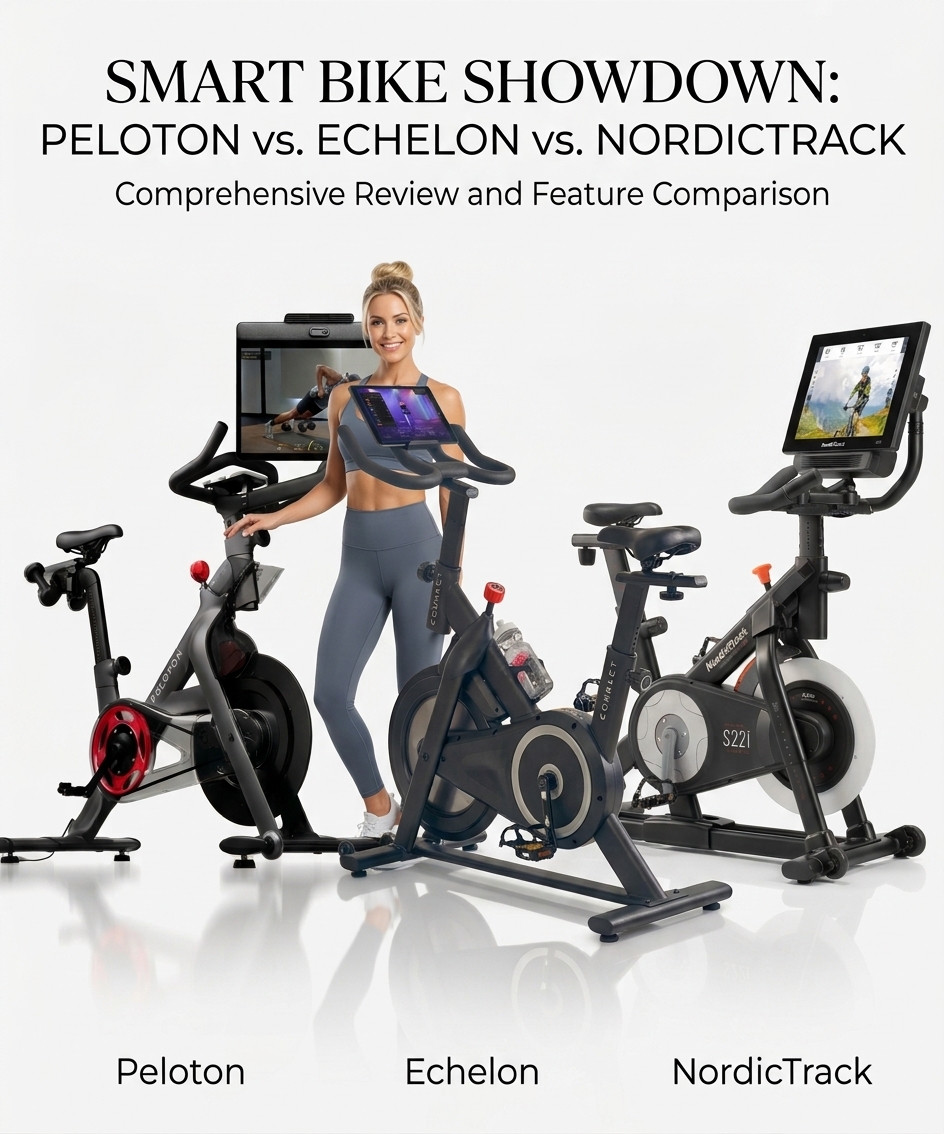
- Smart Bike Comparison at a Glance
- What Is a Smart Exercise Bike?
- Peloton Bike / Bike+ Review
- NordicTrack S15i / S22i Review
- Echelon EX-5 Series Review
- Peloton vs NordicTrack vs Echelon: Head-to-Head
- Which Smart Bike Has the Best Workouts?
- Estimated Total Cost of Ownership
- Which Smart Bike Is Best for You?
- Smart Bike Alternatives Worth Considering
- Common Smart Bike Buying Mistakes
- FAQ
- Final Verdict
Three of the biggest names in connected cycling, but which smart bike is actually worth the money? Peloton built the category and still sets the standard for polished, instructor-led classes. NordicTrack answers with its iFit ecosystem and immersive scenic rides. Echelon undercuts both on price while offering surprisingly similar hardware.
This guide compares all three across bike quality, workout content, subscription costs, technology, comfort, and long-term ownership, so you can figure out which one actually fits your training style and budget. Quick preview: Peloton is our best overall pick, NordicTrack wins for immersive, varied training, and Echelon is the best value.
One thing worth knowing before you spend $1,500 or more: a smart bike is a cardio tool, and indoor cycling itself is one of the best low-impact options out there for your joints. If you’re weighing a bike against other equipment, our guide to the best low-impact cardio workouts is worth a look alongside this comparison.
Smart Bike Comparison at a Glance
| Feature | Peloton Bike / Bike+ | NordicTrack S15i / S22i | Echelon EX-5 / EX-5s-22 |
|---|---|---|---|
| Starting price | $1,695 / $2,695 | $1,599 / $1,899 | ~$999–1,499 / ~$1,799 |
| Monthly membership | $49.99 (All-Access) | $39 (iFit Family, 1 yr free) | $39.99 (Premier) |
| Screen size | 21.5″ / 23.8″ swivel | 14″ / 22″ swivel | None (device holder) / 22″ |
| Resistance system | Manual knob / Auto-resistance | Silent magnetic, auto on S22i | Manual / auto on higher tiers |
| Adjustability | Seat, handlebar, screen tilt | Seat, handlebar, incline/decline | Seat, handlebar (4-way) |
| Live/on-demand classes | Extensive, daily live schedule | Yes, smaller live schedule | Yes, daily live classes |
| Scenic rides | Limited | Extensive (Google Maps rides) | Limited |
| Strength/cross-training | Extensive, off-bike library | Extensive, cross-equipment | Growing, off-bike library |
| Warranty | 12 months (parts & labor) | Varies by retailer, often 1 yr frame | 1 yr standard, 5 yrs for Premier members |
| Best for | Polished classes & community | Immersive, varied training | Budget-conscious buyers |
What Is a Smart Exercise Bike?
A smart bike is a stationary bike with a built-in or attachable screen that streams live and on-demand fitness classes, tracks your performance in real time, and (on higher-end models) automatically adjusts resistance to match an instructor’s cues.
Smart bike vs. traditional stationary bike: A traditional stationary bike just spins; you set your own resistance and watch your own clock. A smart bike adds connected classes, tracked metrics, and often automatic resistance control.
Connected classes and interactive workouts: All three brands here stream video classes, live or recorded, led by real instructors, with music, pacing cues, and (usually) a leaderboard or community element.
Automatic resistance: On the higher-end models from all three brands, the bike can automatically change resistance to match what the instructor calls out, so you don’t have to manually adjust a dial mid-class.
Performance tracking: Output, cadence, resistance, heart rate (with a compatible monitor), and ride history are tracked automatically and saved to your profile.
Instructor-led vs. self-guided training: You can use any of these bikes without ever taking a class, but the entire value proposition of a smart bike is built around structured, instructor-led sessions. Research on exercise adherence consistently finds that structured, instructor-led sessions tend to support more consistent participation than unstructured solo training.[^2]
Who benefits most from a smart bike? People who stay motivated by structure, music, and a bit of community or competition tend to get the most out of this category. If you’re someone who’s happy to just put on a podcast and pedal at your own pace, a smart bike’s premium price may not be worth it for you.
Peloton Bike / Bike+ Review

Best for: Riders who prioritize polished classes, instructor talent, and community, and who don’t mind paying the highest subscription price in this comparison.
What You Get
Bike design and build quality: The current Cross Training Bike weighs 129 lbs, measures 54″ L x 23″ W x 61″ H, and fits a compact 4′ x 2′ footprint. It’s rated for riders 4’11” to 6’5″ and up to 297 lbs.
Display and user interface: The base Bike has a 21.5″ Full HD swivel touchscreen that rotates a full 360º for off-bike classes like strength and yoga. The Bike+ steps up to a 23.8″ screen.
Resistance and ride feel: The base Bike uses a manual resistance knob; you twist it yourself to match the instructor’s calls. The Bike+ adds auto-resistance, which changes the resistance for you in real time, widely considered its single biggest upgrade over the base model.
Instructor-led classes: Peloton’s instructor roster and class library are the most extensive and polished in this category, spanning cycling, strength, yoga, bootcamp, running, and more.
Live vs. on-demand content: Peloton offers a large daily live class schedule in addition to its enormous on-demand library.
App ecosystem: The Peloton App extends classes beyond the bike itself, and equipment now integrates with Apple Health, Garmin Connect, and Fitbit.
Pros & Cons
Strengths: The most polished instructor talent and class variety in the category, a strong leaderboard/community feel, and (on Bike+) genuinely useful auto-resistance and a movement-tracking camera for form feedback during strength work.
Weaknesses: The highest membership cost of the three brands, and touchscreens have a known failure rate in the 3-to-5-year range on used units.
Membership costs/value: The required All-Access Membership costs $49.99 per month (raised from $44 in October 2025), covering unlimited profiles on one bike per household.[3] Lower-cost App+ ($28.99/mo) and App One ($12.99–$15.99/mo) tiers exist but don’t unlock full on-bike metrics or the leaderboard.
A safety note worth knowing: Peloton has issued two seat-post recalls in recent years, one in 2023 covering 2.2 million original Bikes, and a second in November 2025 covering 833,000 original Bike+ units, both due to the seat post potentially breaking during use.[1] Both were resolved with a free, self-installable replacement part, and the redesigned seat post was already built into the current Cross Training line before it launched, so new purchases aren’t affected. If you’re buying used, it’s worth confirming the seat post has been replaced.
NordicTrack S15i / S22i Review

Best for: Riders who want incline/decline training, scenic variety, and a broader cross-training ecosystem beyond just cycling.
What You Get
Bike design and adjustability: Both the S15i and S22i have fully adjustable seats and handlebars, and both include incline and decline capability, up to 20% incline and -10% decline, a feature neither Peloton nor Echelon’s comparable models offer.
Display/technology: The S15i has a 14″ HD swivel touchscreen; the S22i steps up to a 22″ HD swivel touchscreen with faster Wi-Fi and improved graphics.
Resistance and incline/decline capabilities: NordicTrack’s Silent Magnetic Resistance (SMR) system is genuinely quiet, and on both models, iFit trainers can automatically control resistance, incline, and decline together for a hands-off, trainer-led ride.
iFIT workout library: iFit’s content leans heavily on real-world scenic rides filmed on location, alongside trainer-led studio classes.
Trainer-led and scenic workouts: The scenic Global Workouts, where you follow a trainer biking through a real filmed location using Google Maps integration, are NordicTrack’s signature feature and something neither Peloton nor Echelon really replicates.
Cross-training ecosystem: A single iFit membership works across NordicTrack’s treadmills, ellipticals, and rowers too, which is a real advantage if you’re building out a broader home gym over time.
Pros & Cons
Strengths: Incline/decline capability, an extensive scenic-ride library, and a lower entry price than Peloton for comparable screen sizes.
Weaknesses: A noticeably smaller live class schedule than Peloton, more complicated assembly according to several independent reviewers, and inconsistent warranty terms depending on where you buy.
Membership costs/value: Both bikes include one year of a free iFit family membership. After that, plans run $39 per month (or $396 per year) for family access, or $180 per year for an individual plan.
Echelon EX-5 Series Review

Best for: Buyers looking for a genuinely lower-cost entry into connected cycling who don’t need incline/decline or Peloton’s full instructor roster.
What You Get
Bike design: Echelon’s Smart Connect lineup spans several tiers. The entry-level EX-5 has no built-in screen (you use a device holder for your phone or tablet), while the EX-5s-22 adds a 22″ HD rotating touchscreen and the flagship EX-8s goes up to a 24″ curved display.
Screen/connectivity options: Because the EX-5 skips the built-in screen, it’s the most compact and least expensive way into this category; you’re trading the integrated display for a lower price.
Resistance system: All Echelon Smart Connect bikes use magnetic resistance with 32 levels, paired with a substantial flywheel (28 lbs on the EX-5 and EX-5s-22).
Echelon membership: The Echelon Premier membership costs $39.99 per month, or roughly $33 per month billed annually, and unlocks the full class library plus an extended 5-year warranty (versus 1 year without an active membership).
Live and on-demand classes: Echelon’s app has a genuinely mature content library at this point, with daily live classes and thousands of on-demand videos across cycling, rowing, running, strength, and more.
Compatibility with third-party apps: Unlike Peloton and NordicTrack, Echelon’s FitPass tier can also be purchased on its own for off-equipment use, and the platform is built to work across Echelon’s broader equipment lineup (rowers, mirrors, treadmills).
Pros & Cons
Strengths: By far the lowest cost of entry, especially on the screen-free EX-5, plus a genuinely capable app and a strong warranty incentive for active members.
Weaknesses: No incline/decline capability, a smaller instructor roster than Peloton, and Echelon’s model naming and pricing shift frequently with promotions, so it’s worth double-checking current specs before buying.
Membership costs/value: At $39.99/month (or ~$33/month annual), Echelon’s membership sits between Peloton’s and NordicTrack’s, but the lower hardware price gives it the best overall value in this comparison.
Peloton vs NordicTrack vs Echelon: Head-to-Head
Bike Quality & Ride Feel
All three brands build sturdy, stable frames suitable for daily use. Peloton and NordicTrack’s higher-end models generally get the most praise for pedaling smoothness; Echelon’s heavier flywheel models are comparably smooth but slightly less refined by most independent testers’ accounts.
Classes & Content
Peloton wins on instructor quality and live class volume. NordicTrack wins on scenic variety and cross-equipment content. Echelon’s library has matured significantly and now sits reasonably close to both, without quite matching Peloton’s roster depth.
Technology
Auto-resistance is available on Peloton Bike+, NordicTrack’s S22i (paired with auto incline/decline), and Echelon’s higher tiers. Screen quality is broadly comparable at similar sizes across brands. Peloton’s app compatibility (Apple Health, Garmin, Fitbit) is currently the most extensive.
Membership Cost
Peloton’s All-Access Membership ($49.99/mo) is the most expensive of the three. Echelon’s Premier ($39.99/mo, or ~$33/mo annual) and NordicTrack’s iFit ($39/mo, or $180–396/yr) land close together, with NordicTrack’s individual annual plan being the cheapest ongoing option among all three if you don’t need multiple profiles.
Comfort & Fit
All three offer adjustable seats and handlebars. NordicTrack’s incline/decline adds a training dimension the others don’t offer. Peloton’s height range (4’11″–6’5″) is clearly published; verify fit ranges directly with NordicTrack and Echelon before buying, since these can vary by model.
Value
Considering hardware plus a realistic multi-year membership commitment, Echelon generally delivers the most content and features per dollar spent, while Peloton delivers the most polished experience for a real premium.
Which Smart Bike Has the Best Workouts?
Choose your training style:
- Weight loss: Any of the three work well when paired with consistent effort and a sensible eating plan; Peloton’s larger live class variety may help keep workouts from feeling repetitive over time.
- Endurance: NordicTrack’s scenic Global Workouts are a strong match for riders who want long, immersive sessions.
- HIIT: Peloton and Echelon both offer dedicated interval-style classes; Peloton’s library is deeper here.
- Beginner cycling: Echelon’s lower-cost entry point (especially the screen-free EX-5) is a lower-risk way to try the category.
- Competitive cyclists: Peloton’s leaderboard and Power Zone training programs are the most developed for structured, metrics-driven training.
- Cross-training: NordicTrack’s iFit ecosystem, which spans treadmills, ellipticals, and rowers, is the strongest pick if you plan to expand beyond just a bike.
- Strength training: Peloton’s off-bike strength library is the most extensive of the three.
- Motivation/accountability: Peloton’s community and leaderboard features are generally considered the strongest motivational tool in this category, consistent with broader research showing that structured, socially connected exercise settings tend to support better adherence than solo training.[2]
Estimated Total Cost of Ownership
| Peloton (Bike) | NordicTrack (S22i) | Echelon (EX-5s-22) | |
|---|---|---|---|
| Bike purchase price | $1,695 | $1,899 | ~$1,799 |
| Membership (annual) | $599.88 (All-Access) | $396 (Family) or $180 (Individual) | ~$400 (annual Premier) |
| Accessories (shoes, weights, mat) | ~$150–250 | ~$100–200 | ~$100–200 |
| 1-year cost | ~$2,445–2,545 | ~$2,195–2,495 | ~$2,300–2,400 |
| 3-year cost | ~$3,645–3,745 | ~$2,987–3,287 | ~$3,100–3,200 |
| 5-year cost | ~$4,845–4,945 | ~$3,779–4,079 | ~$3,900–4,000 |
The gap widens considerably over time. Even though NordicTrack and Echelon have similar upfront prices to Peloton’s base Bike, their lower ongoing membership costs mean real long-term savings, often $700 to $1,000 or more over five years compared to Peloton’s All-Access plan.
Which Smart Bike Is Best for You?
- Best overall: Peloton, for the strongest combination of class quality, instructor talent, and community.
- Best for immersive training: NordicTrack, for scenic rides, incline/decline, and cross-equipment variety.
- Best value: Echelon, for the lowest realistic total cost of ownership.
- Best for beginners: Echelon’s EX-5, thanks to its lower price and lower financial risk while you figure out if connected cycling is for you.
- Best for serious cyclists: Peloton, for its structured training programs and leaderboard-driven competition.
- Best for cross-training: NordicTrack, since one iFit membership covers its entire equipment ecosystem.
- Best budget option: Echelon’s screen-free EX-5, the cheapest genuine entry point into connected cycling in this comparison.
Smart Bike Alternatives Worth Considering
If none of these three feel like a fit, a few other options are worth a look. Schwinn IC4/IC8 bikes work with multiple third-party apps (Peloton App, Zwift, and others) rather than locking you into one ecosystem, which appeals to people who don’t want to commit to a single platform. MYX Fitness bundles a bike with included dumbbells and resistance bands for a more strength-focused hybrid approach. A non-smart spin bike paired with a tablet and a flexible app like Zwift or the Peloton App (no bike required) can replicate much of the experience at a fraction of the hardware cost, if you’re willing to give up some of the integrated metrics tracking.
Consider looking outside these three main brands if your top priority is avoiding a brand-locked subscription, if you already own a non-smart spin bike and just want app-based content, or if budget is your single biggest constraint.
Common Smart Bike Buying Mistakes
- Comparing bikes based only on upfront price. As the total cost of ownership table above shows, membership costs can flip the “cheaper” bike into the more expensive one within a couple of years.
- Ignoring membership costs. All three brands require an ongoing subscription to unlock the full class experience; budget for it before you buy the hardware.
- Choosing a bike without checking fit. Height range, weight capacity, and seat/handlebar adjustability vary by brand and model; confirm these before ordering.
- Assuming every class requires the bike’s native subscription. Some bikes (notably Echelon and some NordicTrack models) can work with certain third-party apps, though features and metrics may be limited without the native membership.
- Underestimating floor space. Even “compact” smart bikes need clearance on all sides and adequate ceiling height; measure your space before ordering.
- Ignoring warranty/service considerations. Warranty terms vary significantly, and on Echelon specifically, your warranty length depends on keeping an active Premier membership.
- Paying for features you won’t use. If you have no interest in scenic rides or incline training, there’s little reason to pay extra for NordicTrack’s signature features; match the bike to how you’ll actually train.
FAQ
Is Peloton better than NordicTrack? It depends on what you value. Peloton generally offers more polished, instructor-led classes and a stronger community feel; NordicTrack offers scenic variety, incline/decline training, and a lower ongoing membership cost.
Is Echelon as good as Peloton? Echelon’s hardware and app have improved significantly and now compete reasonably well with Peloton at a lower price, though Peloton still leads on instructor roster depth and class variety.
Which smart bike is best for home use? All three are designed for home use with compact footprints. NordicTrack’s incline/decline models take up slightly more depth; Echelon’s screen-free EX-5 has the smallest overall footprint.
Is a smart exercise bike worth it? For people who stay motivated by structured, instructor-led classes and are willing to commit to the ongoing subscription cost, yes. If you’re equally happy following free workout videos or riding without structure, a standard stationary bike may serve you just as well for far less money.
Do you need a subscription for a smart bike? Technically no, you can pedal without one, but you’ll lose access to nearly all the class content and, on some models, the automatic resistance features that justify the higher price over a basic stationary bike.
Which smart bike has the best classes? Peloton generally has the deepest and most polished class library, based on instructor count and daily live class volume, though NordicTrack’s scenic rides and Echelon’s growing library both have genuine strengths.
Which is better for beginners: Peloton or Echelon? Echelon’s lower price point, especially on the screen-free EX-5, makes it a lower-risk way to try connected cycling before committing to Peloton’s higher price point.
What is the best alternative to Peloton? Among the three compared here, NordicTrack is the strongest alternative if you want immersive, varied training; Echelon is the strongest alternative if price is your top concern.
Final Verdict
Peloton is the best overall smart bike in this comparison, thanks to its class variety, instructor talent, and the strongest community and leaderboard experience of the three. If you’ll actually use the live classes regularly and value that community feel, the higher membership cost is easier to justify.
That said, it’s not the right choice for everyone. NordicTrack is the better pick if you want scenic variety, incline/decline training, or plan to build out a broader iFit-connected home gym over time. Echelon is the better pick if total cost of ownership matters most to you, since its lower hardware and membership costs add up to meaningful savings over a few years without sacrificing much in class quality.
Whichever you choose, compare total ownership cost, the workout content ecosystem, and actual bike fit for your body, not just the bike’s advertised sticker price. That’s what determines whether you’ll still be using it, and happy with it, three years from now.
References
[^1]: U.S. Consumer Product Safety Commission. “Peloton Recalls Original Series Bike+ Exercise Bikes Due to Fall and Injury Hazards.” November 6, 2025. Also see the related 2023 recall of the original Peloton Bike (model PL-01). View current Peloton recall information
[^2]: “Individual versus group-based interventions: a systematic review and meta-analysis of physical activity, functional, psychosocial and health outcomes.” Nature Human Behaviour, 2026. Read the study
[^3]: Peloton Interactive. “Peloton Membership: Membership Fee Changes.” Official notice of the October 2025 All-Access Membership price increase to $49.99/month. Read the official notice
Additional general guidance on aerobic exercise volume referenced in this article comes from the CDC’s Physical Activity Guidelines for Americans (150–300 minutes of moderate-intensity aerobic activity per week for adults), available at cdc.gov/physical-activity-basics.
This article is for general informational and educational purposes only and is not intended as medical or professional fitness advice. Talk with a doctor before starting a new exercise program, especially if you have an existing heart condition, joint issue, injury, or other health concern. If you are purchasing a used Peloton Bike or Bike+, confirm the seat post has been inspected or replaced under the manufacturer’s recall program before use, and check cpsc.gov for the current status of any exercise equipment recall before buying new or used equipment. Product names, prices, specifications, and membership terms mentioned in this article are accurate as of the time of writing but change frequently across all three brands due to promotions and product updates; always verify current pricing and specs directly with the manufacturer or retailer before purchasing.
Leave a Reply