
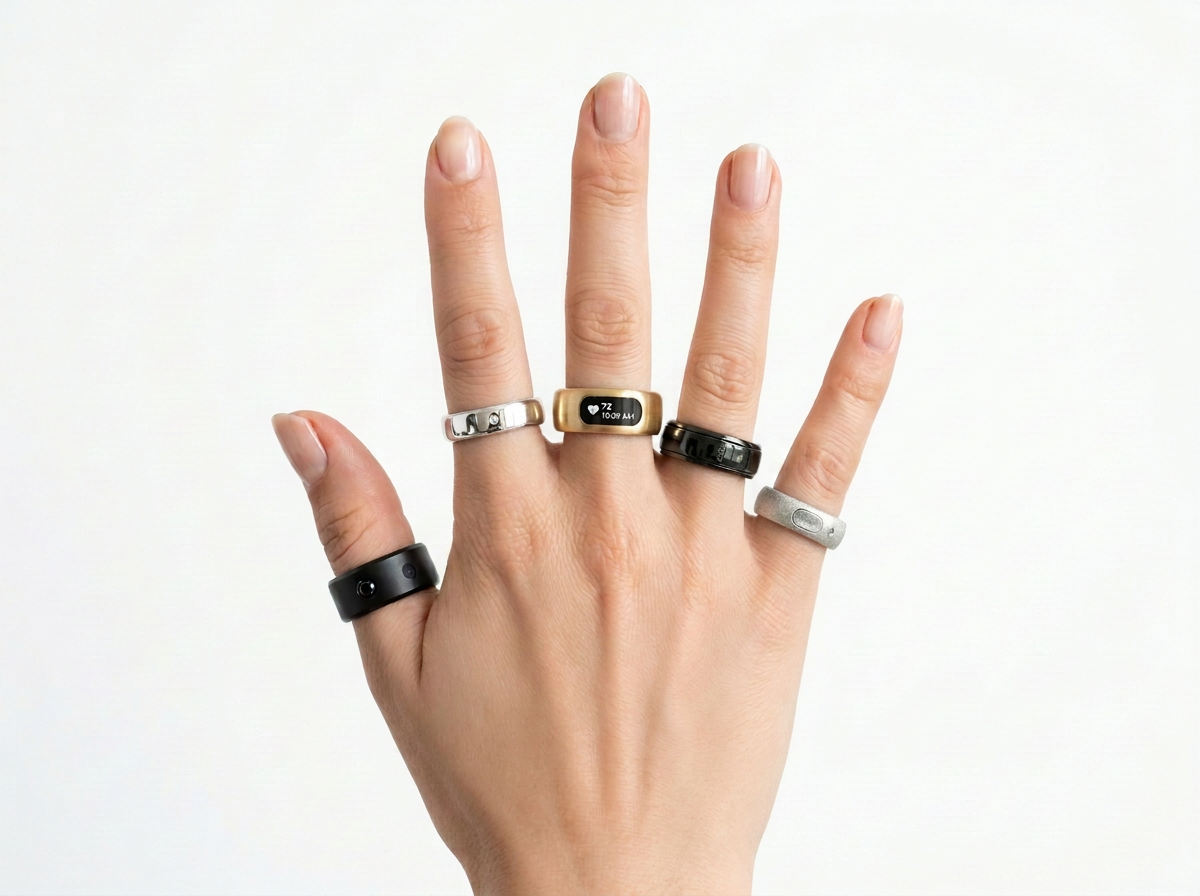
- Smart Ring Health Trackers Comparison: At a Glance
- The Top-Rated Smart Rings for Health Tracking
- What Can a Smart Ring Actually Track?
- How Accurate Are Smart Rings?
- How to Choose the Best Smart Ring for You
- Smart Ring vs. Smartwatch: Which Is Better for Health Tracking?
- Do Smart Rings Require a Subscription?
- Frequently Asked Questions
- Final Verdict: Which Smart Ring Should You Buy?
Smart rings have become one of the fastest-growing alternatives to smartwatches, and it’s easy to see why. They track many of the same health metrics, but you can sleep in them comfortably, forget you’re wearing them by day two, and never have to look at a screen full of notifications. For a lot of people, that’s exactly the point: quiet, passive health data without the extra tech in your face.
A good smart ring can track sleep, heart rate, heart rate variability (HRV), activity, recovery, skin temperature, and blood oxygen, all from a device the size of, well, a ring. But models vary a lot in what they measure, how they present it, and whether you’ll pay a monthly fee to actually see your own data. No single ring is best for everyone, so this guide breaks down the top-rated options and what actually separates them.
One more thing worth understanding before you buy: a smart ring tells you about your health, but it isn’t a substitute for actually improving it. If you want to see how the metrics these rings track (like resting heart rate and HRV) relate to the numbers on a standard fitness tracker, our breakdown of the most common fitness tracker metrics explained is a helpful companion to this guide.
The Oura Ring 5 is the best overall pick for most people, though it requires a subscription. The Samsung Galaxy Ring is the top choice if you own a Samsung phone. RingConn Gen 3 is the strongest no-subscription option overall. The Ultrahuman Ring Pro leads on fitness and recovery tracking, with class-leading battery life. And if budget is the deciding factor, the Amazfit Helio Ring is the cheapest ring worth actually buying.
Smart Ring Health Trackers Comparison: At a Glance
| Ring | Best For | Price | Subscription? | Sleep | Heart Rate | Battery | Compatibility |
|---|---|---|---|---|---|---|---|
| Oura Ring 5 | Best Overall | $399–$499 | Yes ($5.99/mo) | Yes | Yes | 6–9 days | iOS & Android |
| Samsung Galaxy Ring | Samsung Users | $399.99 | No | Yes | Yes | Up to 7 days | Android (Samsung) only |
| RingConn Gen 3 | No Subscription | $349 | No | Yes | Yes | 11–14 days | iOS & Android |
| Ultrahuman Ring Pro | Fitness & Recovery | TBD | No | Yes | Yes | Up to 15 days | iOS & Android |
| Amazfit Helio Ring | Best Budget | ~$199.99 (often on sale) | No | Yes | Yes | ~2.5–4 days | iOS & Android |
The Top-Rated Smart Rings for Health Tracking
1. Oura Ring 5 — Best Overall

Oura remains the name most people think of first, and the Ring 5 is a genuine step forward: it’s 40% smaller than the Ring 4, built from titanium, and packs in over 50 health metrics.
Health and sleep tracking: Oura tracks total sleep, sleep stages (light, deep, REM), sleep regularity, resting heart rate, HRV, blood oxygen, breathing regularity, and skin temperature, all rolled into a daily Sleep Score.
Readiness and recovery insights: The Readiness Score blends sleep, HRV, temperature, and recent activity into a single number that’s genuinely useful for deciding how hard to train or whether to rest.
Sleep accuracy and usability: Oura’s sleep staging has held up well against polysomnography (the clinical gold standard) in independent research, correctly distinguishing wake from sleep more than 95% of the time, though sleep-stage discrimination specifically is harder for every wearable, Oura included.[1]
App experience: The Oura app is polished and easy to navigate, and new features like GLP-1 Insights and (in the U.S.) Blood Pressure Signals show the platform is still actively expanding.
Battery life: 6 to 9 days per charge, shorter than some no-subscription competitors, but reasonable for a ring this compact.
Subscription cost: $5.99/month or $69.99/year, required for the Readiness Score, sleep stage analysis, and most personalized insights. The first month is included free with purchase.
Best for: Anyone who wants the most polished, actively developed platform and doesn’t mind paying for it. Drawbacks: Recurring cost, and you’ll need to order a sizing kit first, since Oura’s sizing doesn’t match standard ring sizes.
2. Samsung Galaxy Ring — Best for Samsung Users

Samsung’s debut ring is built specifically around the Galaxy ecosystem, and it shows in how deeply it ties into Samsung Health.
Samsung Health integration: Sleep, activity, and heart data sync directly into Samsung Health alongside data from a Galaxy Watch, if you own one, and Galaxy AI powers the daily Energy Score.
Sleep and activity tracking: Covers sleep stages, resting heart rate, HRV, blood oxygen, and skin temperature, plus automatic activity detection for common exercises.
Galaxy ecosystem features: Samsung has announced that Galaxy Ring will become the first FDA-cleared, over-the-counter smart ring for sleep apnea risk detection, with the feature rolling out this fall.[note-samsung] That’s a meaningful upcoming addition, though it isn’t live yet as of this writing.
Battery and charging case: Up to 7 days per charge, in the middle of the pack for this category.
Compatibility limitations: This is the big one. The Galaxy Ring only works with Android phones, specifically recent Samsung Galaxy devices, so it’s a non-starter for iPhone users.
Best for: Samsung phone owners who want deep integration with Samsung Health and no subscription fee. Drawbacks: Android/Samsung-only.
3. RingConn Gen 3 — Best No-Subscription Smart Ring

RingConn built its entire brand around never charging a subscription, and the Gen 3 adds meaningful new features on top of that same promise.
Health metrics: Heart rate, HRV, SpO2, respiratory rate, skin temperature, stress, sleep apnea pattern screening (not FDA-cleared), and a new Vascular Health Trend Insights feature that flags overnight blood-pressure-related trends, explicitly framed as a wellness feature rather than a medical measurement.
Sleep tracking: Detailed stages and a nightly Sleep Score, plus the sleep apnea screening mentioned above.
Battery life: The standout feature here. RingConn rates the Gen 3 at 11 to 14 days per charge (10 to 12 if you leave the new haptic vibration motor turned on), among the best in the category.
App experience: Functional and improving, though reviewers consistently note it’s less polished than Oura’s or Ultrahuman’s.
Cost of ownership: At $349 with zero ongoing fees, and HSA/FSA eligibility, it’s hard to beat on total cost of ownership.
Best for: Anyone who wants strong all-around tracking and refuses to pay a monthly fee, and specifically wants the longest battery life available. Drawbacks: The vibration motor only handles health alerts, it doesn’t support message or call notifications, and the app still trails the category leaders in polish.
4. Ultrahuman Ring Pro — Best for Fitness & Recovery

Ultrahuman has always positioned itself as the performance-focused, no-subscription alternative to Oura, and the Ring Pro pushes that further with genuinely class-leading battery life.
Recovery and movement tracking: The Dynamic Recovery Score blends HRV, resting heart rate, and skin temperature into an actionable daily number, and it updates in real time for naps or sauna sessions, not just overnight sleep.
Sleep monitoring: Full sleep-stage breakdown (REM, deep, light, wake) plus a running sleep debt tally.
Workout insights: Ultrahuman’s app leans harder into training and recovery framing than most competitors, which is where its “performance” positioning comes through.
No recurring subscription: Core features are included for life with the one-time purchase. Optional add-ons called PowerPlugs are free for the first year, then become paid extras if you choose to keep them, worth knowing so you’re not surprised later.
Best for athletes: Up to 15 days of battery life (about 12 in higher-fidelity “Turbo” mode), extendable to 45 days combined with the included PRO Charging Case, plus 250 days of on-ring data storage that doesn’t require constant phone syncing.
Drawbacks: It’s the most expensive ring on this list. The redesigned Ring Pro cleared U.S. Customs and began shipping to early backers in June 2026, but broader retail shipments (including sizing kits for new orders) are scheduled to begin September 15, 2026.
5. Amazfit Helio Ring — Best Budget Option

If you just want to try a smart ring without a big financial commitment, the Helio Ring is the most affordable option here that’s still genuinely worth buying.
Health monitoring: Heart rate, blood oxygen, skin temperature, and an EDA (electrodermal activity) sensor for stress tracking, all combined into a BioCharge readiness score, plus VO2 Max estimates via the Zepp app.
Sleep and recovery data: Solid, if less granular than Oura’s or Ultrahuman’s, sleep staging, alongside basic workout tracking for running, walking, cycling, and treadmill sessions.
Coaching features: No dedicated coaching layer, but it integrates cleanly with Amazfit smartwatches through the shared Zepp app if you already own one.
Battery and comfort: This is the tradeoff for the price. Amazfit officially rates it at up to 4 days, but independent testing has found real-world battery life closer to 2.5 to 3 days with full monitoring enabled, noticeably shorter than every other ring on this list.
App experience: Zepp’s app is functional but less refined than Oura’s or Ultrahuman’s, and sizing is limited to just three options (8, 10, and 12), which can rule out smaller or larger fingers entirely.
Best for: Budget-conscious buyers, or existing Amazfit smartwatch owners who want overnight tracking without wearing their watch to bed. Drawbacks: Shortest battery life in this category, limited sizing, and (like Samsung) currently part of an unresolved patent dispute with Oura.
What Can a Smart Ring Actually Track?
Sleep: Duration, sleep stages, and an overall sleep score are standard across every ring on this list.
Heart rate: Both your resting heart rate and continuous heart rate throughout the day and night.
HRV: Heart rate variability, the tiny variations in time between heartbeats, is widely used as a proxy for how recovered or stressed your nervous system is.
Blood oxygen: Overnight SpO2 trends, which can flag breathing disturbances during sleep.
Body temperature: Skin temperature changes and trends, useful for spotting illness onset or, for some users, cycle tracking.
Activity: Steps, calories, and general movement throughout the day, with varying levels of dedicated workout detection.
Recovery/readiness: Every brand has its own name for this (Readiness Score, Energy Score, Dynamic Recovery Score), but they’re all doing roughly the same thing: combining sleep, HRV, and temperature into one daily number.
Stress: Most rings estimate stress from HRV and heart rate patterns; Amazfit’s Helio Ring adds a dedicated EDA sensor for a more direct read on skin conductance.
What Smart Rings Can’t Diagnose
It’s worth being clear-eyed here: these are wellness devices, not medical devices, with a couple of narrow exceptions (like Samsung’s upcoming FDA-cleared sleep apnea risk feature). A smart ring can flag a pattern, elevated resting heart rate, disrupted breathing, an unusual temperature trend, but it cannot diagnose a heart condition, sleep apnea, or any other medical issue on its own. Persistent or concerning readings are a reason to talk to a doctor, not a substitute for one.
How Accurate Are Smart Rings?
Accuracy varies quite a bit depending on what’s being measured. In a same-night comparison against polysomnography (the clinical gold standard for sleep studies), the Oura Ring correctly distinguished sleep from wake more than 95% of the time, similar to the Fitbit and Apple Watch tested alongside it; distinguishing between individual sleep stages was harder for all three devices, with sensitivity ranging from roughly 50% to 86% depending on the stage.[1] It’s worth noting that study was funded by Oura itself, which doesn’t invalidate the results but is worth knowing when you read it.
A separate, independently run study that tested ring trackers specifically (including Oura) against overnight sleep studies in a real clinical population, rather than only healthy volunteers, found broadly similar patterns: strong at detecting whether you’re asleep, less precise at classifying exactly which stage you’re in.[2]
Workout tracking tends to be the weaker category across the board. A ring worn on your finger simply can’t capture movement as precisely as a device worn on your wrist for activities involving grip strength, like weightlifting.
The most useful way to think about any of this data is as a trend, not a verdict. A single “bad” sleep score doesn’t mean much on its own, but a week of declining HRV or rising resting heart rate is a much more meaningful signal. In fact, researchers have documented cases where people become so fixated on hitting a perfect daily score that it actually worsens their sleep, a pattern researchers have named “orthosomnia.”[3] If checking your ring’s score every morning is adding stress rather than insight, that’s worth paying attention to as well.
How to Choose the Best Smart Ring for You
- Best sleep tracking: Oura Ring 5 or Ultrahuman Ring Pro, both offer the most detailed sleep-stage breakdowns.
- Best recovery tracking: Oura Ring 5 (Readiness Score) or Ultrahuman Ring Pro (Dynamic Recovery Score).
- Best fitness tracking: Ultrahuman Ring Pro, for its training-focused app and metrics.
- Best for iPhone: Oura Ring 5 or Ultrahuman Ring Pro, both have polished iOS apps.
- Best for Android/Samsung: Samsung Galaxy Ring, if you own a compatible Galaxy phone.
- Best without a subscription: RingConn Gen 3.
- Best battery life: Ultrahuman Ring Pro (up to 15 days), followed closely by RingConn Gen 3 (11–14 days).
- Best value: RingConn Gen 3 for full features, or Amazfit Helio Ring if price is the top priority.
- Best for beginners: Amazfit Helio Ring, for the lowest financial commitment while you figure out if a ring fits your routine.
Smart Ring vs. Smartwatch: Which Is Better for Health Tracking?
| Feature | Smart Ring | Smartwatch |
|---|---|---|
| Health tracking | Strong for sleep, HRV, recovery | Strong across the board, plus more sensors |
| Sleep comfort | Excellent, barely noticeable | Bulkier, some find it uncomfortable |
| Workout tracking | Weaker, especially grip-based exercise | Stronger, especially with GPS |
| GPS | Rare or absent | Common, often built in |
| Notifications | Minimal or none | Full notification support |
| Battery life | Days to weeks | Typically 1–7 days |
| Comfort | Very high, easy to forget it’s there | Moderate, more noticeable |
| Distraction | Low, no screen | Higher, always-visible notifications |
| Price | $200–$500 | $200–$800+ |
Rather than choosing one over the other, many people find rings and watches complement each other: a ring for passive, overnight tracking and a watch for workouts, GPS, and notifications during the day.
Do Smart Rings Require a Subscription?
It depends on the brand. Oura is the main subscription-based option in this category, charging $5.99/month or $69.99/year for full access to its scores, trends, and personalized insights; without it, you’re left with basic raw data. Samsung, RingConn, Ultrahuman, and Amazfit all include their core features with the one-time hardware purchase, no ongoing fee required.
Estimated 3-year cost of ownership:
- Oura Ring 5: ~$399 (hardware, first year free) + ~$140 (two more years of membership) ≈ $539
- Samsung Galaxy Ring: $399.99 (no subscription)
- RingConn Gen 3: $349 (no subscription)
- Ultrahuman Ring Pro: $479 (no subscription)
- Amazfit Helio Ring: ~$199.99 (no subscription)
Subscription cost matters because it changes which ring is actually cheapest over time, not just at checkout. A $349 ring with no fees can end up costing less over three years than a $349 ring plus a monthly membership, even though they start at the same price.
Frequently Asked Questions
Are smart rings worth it for health tracking? For most healthy adults who want passive insight into sleep, recovery, and general trends, yes. Just remember they’re wellness tools, not diagnostic devices.
What is the best smart ring for sleep tracking? Oura Ring 5 and Ultrahuman Ring Pro currently offer the most detailed sleep-stage breakdowns, though all five rings on this list track basic sleep duration and quality.
Which smart ring has the most accurate health tracking? Independent research has found Oura’s sleep-wake detection to be strong, though sleep-stage accuracy is imperfect across every brand tested, including Oura.[^1][^2] No smart ring is perfectly accurate, so trends matter more than any single reading.
Is Oura better than Samsung Galaxy Ring? Oura generally offers deeper insights and a more polished app; Samsung offers no subscription and tighter integration if you own a Galaxy phone. Neither is universally “better,” it depends on your phone and whether you want to pay a monthly fee.
What is the best smart ring without a subscription? RingConn Gen 3 is the strongest all-around no-subscription option, with the Ultrahuman Ring Pro a strong (pricier) alternative if battery life and fitness tracking matter most to you.
Can smart rings track blood pressure? Not with clinical accuracy. RingConn’s Vascular Health Trend Insights and Oura’s Blood Pressure Signals estimate wellness-level trends, not clinical blood pressure readings, and neither should replace a proper blood pressure cuff.
Can a smart ring detect health problems? It can flag unusual patterns, like elevated resting heart rate or disrupted breathing, that are worth discussing with a doctor. With the narrow exception of Samsung’s upcoming FDA-cleared sleep apnea risk feature, smart rings are not approved to diagnose medical conditions.
Do smart rings work with iPhone? Oura, RingConn, Ultrahuman, and Amazfit all work with iOS. The Samsung Galaxy Ring is the exception, it’s Android/Samsung-only.
How long do smart rings last? Most smart rings are designed to last 2 to 4 years with daily wear before battery degradation becomes noticeable, similar to a smartwatch, though this varies by brand and usage.
Can you wear a smart ring all day? Yes, that’s the point. Most are rated for continuous wear, including in the shower or while swimming (check individual water-resistance ratings), and are specifically designed to be comfortable enough for 24/7 use, including overnight.
Final Verdict: Which Smart Ring Should You Buy?
Want the best overall? → Oura Ring 5. It remains the most polished, well-validated option, and the subscription is a fair trade if you’ll actually use the insights.
Want the best no-subscription pick? → RingConn Gen 3. Full features, exceptional battery life, and zero ongoing cost.
New to smart rings and want to start cheap? → Amazfit Helio Ring. The lowest financial commitment while you figure out whether the category fits your routine.
Own a Samsung phone? → Samsung Galaxy Ring. The tightest integration with Samsung Health, and no subscription.
Want the best fitness and recovery tracking, with the longest battery life? → Ultrahuman Ring Pro, if you’re comfortable with pre-order timing and the higher price.
The right choice ultimately comes down to four things: which phone ecosystem you’re in, whether you’re willing to pay a subscription, which specific health metrics matter most to you, and your budget. There’s genuinely no single “best” ring for everyone, just the one that fits your situation.
References
[^1]: Robbins R, Weaver MD, Sullivan JP, et al. Accuracy of Three Commercial Wearable Devices for Sleep Tracking in Healthy Adults. Sensors. 2024;24(20):6532. Note: this study was funded by Oura Ring Inc. Read the study on PMC
[^2]: Performance of wearable finger ring trackers for diagnostic sleep measurement in the clinical context. Scientific Reports. Independently tested ring trackers, including Oura, against polysomnography in a clinical sleep-disorder population. Read the study on Nature
[^3]: Baron KG, Abbott S, Jao N, Manalo N, Mullen R. Orthosomnia: Are Some Patients Taking the Quantified Self Too Far? Journal of Clinical Sleep Medicine. 2017;13(2):351-354. Read the study on PMC
[^note-samsung]: Samsung announced this feature during its Galaxy Unpacked event in July 2026; it is not yet live as of the time of writing. Source reporting: Gizmodo, Android Central, and Tom’s Guide, July 2026.
This article is for general informational and educational purposes only and is not intended as medical advice. Smart rings are wellness devices, not medical devices (with narrow, specifically labeled exceptions), and their readings should not be used to diagnose, treat, or rule out any health condition. Talk with a doctor about any persistent or concerning symptoms rather than relying on wearable data alone, and consult a healthcare provider before making health decisions based on this or any wearable device. Product names, prices, specifications, subscription terms, and availability mentioned in this article, including details of the ongoing patent disputes discussed above, are accurate as of the time of writing but may change; always verify current pricing, features, and legal/availability status directly with the manufacturer or retailer before purchasing.
Leave a Reply